Classification / Noms
Noms communs | Synonymes | Catalog of Fishes(Genre, Espèce) | ITIS | CoL | WoRMS | Cloffa
>
Characiformes (Characins) >
Stevardiidae (Stevardiids) > Stevardiinae
Etymology: Pseudocorynopoma: Greek, pseudes = false + Greek, koryne = stick + Greek, poma = cover, operculum (Ref. 45335).
Eponymy: Professor Dr Stanley Howard Weitzman (1927–2017) was honoured for his great contribution to our knowledge of Neotropical freshwater fish (see Weitzman, SH). (Ref. 128868), visit book page.
Environnement : milieu / zone climatique / profondeur / gamme de distribution
Écologie
; eau douce benthopélagique. Tropical
South America: Brazil and Uruguay.
Taille / Poids / Âge
Maturité: Lm ? range ? - ? cm
Max length : 6.2 cm SL mâle / non sexé; (Ref. 123882); 6.1 cm SL (female)
Description synthétique
Clés d'identification | Morphologie | Morphométrie
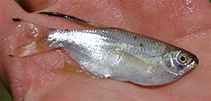
Rayons mous dorsaux (Total) : 9; Rayons mous anaux: 32 - 37; Vertèbres: 37 - 39. This species is distinguished from P. heterandria by the number of branched anal-fin rays 32-36 (vs. 35-40 in P. heterandria); presence in males of an intermediate lobe in the distal margin of the anal fin (vs. absence); presence of hooks on the anal-fin rays of the intermediate lobe only (vs. presence of hooks in the branched anal-fin rays of the anterior lobe); presence of marks coloured in pink, black and white at the tips of the caudal-fin lobes in both sexes (vs. absent). It differs from P. doriae in both sexes by the arrangement of the white, red and black marks at the tip of the dorsal lobe of the caudal fin and in mature males by the absence of black spots at the distal tip of the pectoral fin and by the absence of black spots in the distal tip of the rays of the anterior lobe of the anal fin (vs. present in P. doriae); differs further by the growth patterns of the caudal peduncle length in females and of the anal-fin base length in males and by 87 mutational steps in mtDNA sequences (COI and ND2) (Ref. 123882).
Cross section: compressed.
Cycle de vie et comportement reproducteur
Maturité | Reproduction | Frai | Œufs | Fécondité | Larves
Malabarba, L.R., J. Chuctaya, A. Hirschmann, E.B. de Oliveira and A.T. Thomaz, 2020. Hidden or unnoticed? Multiple lines of evidence support the recognition of a new species of Pseudocorynopoma (Characidae: Corynopomini). J. Fsh. Biol. 98(1):219-236. (Ref. 123882)
Statut dans la liste rouge de l'IUCN (Ref. 130435: Version 2025-2 (Global))
Menace pour l'homme
Harmless
Utilisations par l'homme
Outils
Articles particuliers
Télécharger en XML
Sources Internet
Estimations basées sur des modèles
Indice de diversité phylogénétique (Réf.
82804): PD
50 = 0.6250 [Uniqueness, from 0.5 = low to 2.0 = high].
Bayesian length-weight: a=0.01995 (0.00906 - 0.04395), b=3.01 (2.83 - 3.19), in cm total length, based on all LWR estimates for this body shape (Ref.
93245).
Niveau trophique (Réf.
69278): 3.0 ±0.4 se; based on size and trophs of closest relatives
Vulnérabilité de la pêche (Ref.
59153): Low vulnerability (10 of 100).
🛈