>
Syngnathiformes (Pipefishes and seahorses) >
Syngnathidae (Pipefishes and seahorses) > Syngnathinae
Etymology: Hippocampus: Greek, ippos = horse + Greek,kampe = curvature (Ref. 45335); nalu: Named for Savannah Nalu Olivier who discovered the new species in Sodwana Bay. In the South African languages, Xhosa and Zulu, nalu refers to the expression ‘here it is’ and therefore we extend its meaning in this case to the simple fact that H. nalu was there all along until its discovery. The name nalu is also the Hawaiian word that refers to the waves or surf of the moana (ocean), and thus relevant to this species which was observed moving about in strong surge to different locations in the sandy habitat; a noun in the genitive.
Eponymy: Savannah Nalu Olivier is an Instructor and Dive Master at Pisces Diving, Sodwana Bay, South Africa. [...] (Ref. 128868), visit book page.
Environnement : milieu / zone climatique / profondeur / gamme de distribution
Écologie
marin démersal; non migrateur; profondeur 12 - 17 m (Ref. 122372). Tropical
Western Indian Ocean: South Africa. Probably occurring further north off East Africa in Mozambique, Tanzania, and Kenya, and offshore to Madagascar which may be confirmed by future localised ichthyofaunal surveys.
Taille / Poids / Âge
Maturité: Lm ? range ? - ? cm
Max length : 2.2 cm SL mâle / non sexé; (Ref. 122372); 1.9 cm SL (female)
Description synthétique
Clés d'identification | Morphologie | Morphométrie
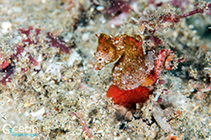
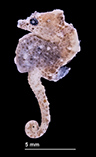
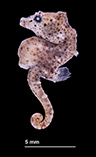
Rayons mous dorsaux (Total) : 12. This species is distinguished by the following set of characters: tail rings 29-30; D 12; pectoral fin rays 10; subdorsal rings 4; there are 2 pairs of bilateral wing-like protrusions behind the head formed by a pair of large oblong spines projecting anterolaterad on the first superior trunk ridge and 1 pair of unique double cuspidate spines projecting anteriad on the second superior trunk ridge; double spine above the eyes; no spines at the sixth superior trunk and eighth inferior trunk ridges; superior trunk ridge ending with two subdorsal spines protruding laterad; posteriormost spine greatly enlarged on twelfth trunk ridge (Ref. 122372).
Cross section: angular.
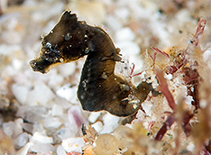
This species remains undetected because of its cryptic behaviour and diminutive size. It is observed in flat sandstone-based coral reefs comprising of low pinnacles, shallow drop offs, and sandy gullies, with the latter being exposed to strong currents. It was found loosely associating with short algal turf, used as a holdfast, which was growing on sand-covered coral bedrock separated by sandy gullies (around 2 meters wide). Ambient seawater temperature averaged ca. 24 °C during the dives, which were conducted in October of 2018. Collectors experienced strong swells on the exposed reefs of 2 Mile Reef during data collection. The holotype and paratype appeared to be a mated pair, found within approximately 60 cm distance of each other on the two dives. Behaviour of the pair was observed prior to collection which was very similar to congeners H. pontohi and H. japapigu. Several individuals, including a small juvenile (ca. 1.0 cm SL), were found in the gullies and observed to be associated with low-growth algal turf. The juvenile, retained the dark colouration of a recently settled juvenile pygmy seahorse (Ref. 122372).
Cycle de vie et comportement reproducteur
Maturité | Reproduction | Frai | Œufs | Fécondité | Larves
Short, G., L. Claassens, R. Smith, M. De Brauwer, H. Hamilton, M. Stat and D. Harasti, 2020. Hippocampus nalu, a new species of pygmy seahorse from South Africa, and the first record of a pygmy seahorse from the Indian Ocean (Teleostei, Syngnathidae). ZooKeys 934:141-156. (Ref. 122372)
Statut dans la liste rouge de l'IUCN (Ref. 130435: Version 2025-2 (Global))
Menace pour l'homme
Harmless
Utilisations par l'homme
Pêcheries: sans intérêt
Outils
Articles particuliers
Télécharger en XML
Sources Internet
Estimations basées sur des modèles
Indice de diversité phylogénétique (Réf.
82804): PD
50 = 0.5000 [Uniqueness, from 0.5 = low to 2.0 = high].
Bayesian length-weight: a=0.00447 (0.00176 - 0.01132), b=3.00 (2.78 - 3.22), in cm total length, based on LWR estimates for this (Sub)family-body shape (Ref.
93245).
Niveau trophique (Réf.
69278): 3.1 ±0.3 se; based on size and trophs of closest relatives
Résilience (Réf.
120179): Haut, temps minimum de doublement de population inférieur à 15 mois (Preliminary K or Fecundity.).
Vulnérabilité de la pêche (Ref.
59153): Low vulnerability (10 of 100).
🛈