Élasmobranches (requins et raies) (sharks and rays) >
Rhinopristiformes (Shovelnose rays) >
Rhinobatidae (Guitarfishes)
Etymology: Rhinobatos: Greek, rhinos = nose + Greek, batis, -idos = a ray (Raja sp.) (Ref. 45335); ranongensis: Named for the Ranong fish landing in western Thailand, where the first specimen was collected 25 years ago, and subsequently most of the types.
Environnement : milieu / zone climatique / profondeur / gamme de distribution
Écologie
marin démersal; profondeur 30 - 69 m (Ref. 123963). Tropical
Eastern Indian Ocean: Andaman Sea, Myanmar and western Thailand.
Taille / Poids / Âge
Maturité: Lm ? range ? - ? cm
Max length : 64.5 cm TL mâle / non sexé; (Ref. 123963); 51.1 cm TL (female)
Description synthétique
Clés d'identification | Morphologie | Morphométrie
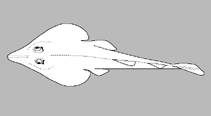
This medium-sized species is distinguished by the following set of characters in adult male: disc is wedge-shaped and relatively narrow, its width 31-33% TL, length 1.3-1.4 times width; snout moderately elongate, its length 3.0–3.2 times interspiracular distance, 4.1-4.4 times interorbital width; orbit and spiracular openings are small, orbit diameter ~1.5 times spiracle length; nostrils weakly oblique, length 1.3-1.6 times internarial distance; mouth narrow, 5.4-6.0% TL; preoral length 6.3-6.9 times internarial distance; posterior nasal flaps are broad; spiracular folds 2, the outermost fold slightly taller than inner fold; ridges of rostral cartilage are almost parallel, converging anteriorly but not constricted medially; anterior cartilage is broadly sickle shaped, truncate posteriorly; gill slits and their interspaces are narrow, distance between fifth gill slits 3.0-3.2 times in ventral head length; prebranchial sensory pore system distinct, extending to just behind margin of first gill slit; postscapular sensory canal indistinct, deeply embedded, not forming shallow groove; thorn patches present on supraorbit and scapular region, and row along dorsal midline rudimentary, inconspicuous; denticles on dorsal fins are densest anteriorly, present but more sparse posteriorly; dorsal fins are small, height of first 5.4-6.2% TL; pelvic-fin inner margin subequal to its base length; interdorsal distance 2.9-3.3 times first dorsal-fin base; dorsal caudal margin 2.0-2.4 times the preventral margin; upper jaw with 68-82 tooth rows; snout angle 59-64°; pectoral radials 64-68; post-synarcual centra 172-176; nasal lamellae 47-48. Colouration: dorsal fins brownish anteriorly, dusky posteriorly; dorsal disc of adults largely uniformly brownish, no spots or obvious blotches; no large, black, teardrop marking on undersurface of snout (Ref. 123963)
Cross section: flattened.
Caught individuals: males at 49.4 and 50.3 cm TL were immature and the largest female (51.1 cm TL) was most probably at late adolescent or early mature stage of development (Ref. 123963).
Cycle de vie et comportement reproducteur
Maturité | Reproduction | Frai | Œufs | Fécondité | Larves
Last, P.R., B. Séret and G.J.P. Naylor, 2019. Description of Rhinobatos ranongensis sp. nov.(Rhinopristiformes: Rhinobatidae) from the Andaman Sea and Bay of Bengal with a review of its northern Indian Ocean congeners. Zootaxa 4576(2):257-287. (Ref. 123963)
Statut dans la liste rouge de l'IUCN (Ref. 130435: Version 2025-2 (Global))
Menace pour l'homme
Harmless
Utilisations par l'homme
Outils
Articles particuliers
Télécharger en XML
Sources Internet
Estimations basées sur des modèles
Indice de diversité phylogénétique (Réf.
82804): PD
50 = 0.5000 [Uniqueness, from 0.5 = low to 2.0 = high].
Bayesian length-weight: a=0.00295 (0.00150 - 0.00581), b=3.13 (2.96 - 3.30), in cm total length, based on LWR estimates for this (Sub)family-body shape (Ref.
93245).
Niveau trophique (Réf.
69278): 3.7 ±0.4 se; based on size and trophs of closest relatives
Résilience (Réf.
120179): Faible, temps minimum de doublement de population : 4,5 à 14 années (Preliminary low fecundity).
Vulnérabilité de la pêche (Ref.
59153): Moderate to high vulnerability (46 of 100).
🛈