Élasmobranches (requins et raies) (sharks and rays) >
Rajiformes (Skates and rays) >
Arhynchobatidae (Softnose skates)
Etymology: Notoraja: Greek, noton = back + Latin, raja = fish, Raja sp. (Ref. 45335); hesperindica: Name from combination of Greek 'hesper' for westerly, and Latin 'indicus' for Indian, referring to the distribution of the new species.
Environnement : milieu / zone climatique / profondeur / gamme de distribution
Écologie
marin bathydémersal; profondeur 1230 - 1600 m (Ref. 123885). Deep-water
Western Indian Ocean: off southern Mozambique and off northwestern Madagascar.
Taille / Poids / Âge
Maturité: Lm ? range ? - ? cm
Max length : 53.3 cm TL mâle / non sexé; (Ref. 123885)
Description synthétique
Clés d'identification | Morphologie | Morphométrie
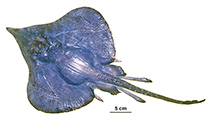
This species is distinguished from most of its congeners by the intense dark blue-grayish coloration and large dorsolateral tail thorns. It is further distinct with the following characters: disc evenly inverse heart-shaped, with broadly rounded outer corners; body length to mid-cloaca is shorter than tail length from mid-cloaca; snout very long direct preorbital length 15.1-16.7% TL.; orbits are relatively small, horizontal diameter 0.9-1.2 times interorbital width; dorsal surface nearly completely devoid of denticles except the trunk area close to pectoral axils where bands of few denticles start and continue as more pronounced rows on tail; anterior tail with several short rows of spinules and a rather regular row of small spinules on lateral tail; one small preorbital thorn on each side; a regular or irregular row of about 16-25 small median tail thorns; lateral tail with 2 irregular rows of about 15-25 dorsolateral thorns that are much larger than the median thorns. Colouration when fresh, the dorsal disc plain intense dark blue, somewhat mottled blackish-brown in the orbital and snout regions, pelvic fins and claspers medium brownish blue, tail dark blackish blue; the ventral surface dark (Ref. 123885).
Cross section: flattened.
Cycle de vie et comportement reproducteur
Maturité | Reproduction | Frai | Œufs | Fécondité | Larves
Weigmann, S., B. Séret and M.F.W. Stehmann, 2021. Notoraja hesperindica sp. nov., a new colorful deep-sea softnose skate (Elasmobranchii, Rajiformes, Arhynchobatidae) and first generic record from the western Indian Ocean. Mar. Biodiv. 51(35):1-19. (Ref. 123885)
Statut dans la liste rouge de l'IUCN (Ref. 130435: Version 2025-2 (Global))
Menace pour l'homme
Harmless
Utilisations par l'homme
Pêcheries: sans intérêt
Outils
Articles particuliers
Télécharger en XML
Sources Internet
Estimations basées sur des modèles
Indice de diversité phylogénétique (Réf.
82804): PD
50 = 0.5000 [Uniqueness, from 0.5 = low to 2.0 = high].
Bayesian length-weight: a=0.00550 (0.00279 - 0.01081), b=3.11 (2.94 - 3.28), in cm total length, based on LWR estimates for this (Sub)family-body shape (Ref.
93245).
Niveau trophique (Réf.
69278): 3.8 ±0.7 se; based on size and trophs of closest relatives
Résilience (Réf.
120179): Milieu, temps minimum de doublement de population : 1,4 à 4,4 années (Preliminary K or Fecundity.).
Vulnérabilité de la pêche (Ref.
59153): Moderate vulnerability (41 of 100).
🛈