Классификация / Имена
народные названия | синонимы | Catalog of Fishes(род, виды) | ITIS | CoL | WoRMS | Cloffa
>
Galaxiiformes (Southern smelts) >
Galaxiidae (Galaxiids) > Galaxiinae
Etymology: Galaxias: Greek, galaxias, ou = a kind of fish (Ref. 45335); brevissimus: Name from Latin 'brevissimus', meaning shortest or small, referring to this species having the shortest caudal peduncle and caudal fin when compared with its congeners in the Galaxias olidus complex.
Окружающая среда: среда / климатическая зона / пределы глубины / диапазон распространения
экология
; пресноводный донно-пелагический; немигрирующий; пределы глубины 0 - 1 m (Ref. 98815). Subtropical
Oceania: Australia.
Размер / Вес / Возраст
половая зрелость: Lm ? range ? - ? cm
Max length : 9.6 cm FL самец/пол неопределен; (Ref. 98815); наибольший вес (опубликованные данные): 7.00 g (Ref. 98815)
Краткое описание
определительные ключи | морфология | морфометрия
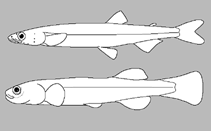
членистые (мягкие) лучи спинного плавника (общее число) : 9 - 10; членистые (мягкие) лучи анального плавника: 10 - 12; позвонки: 51 - 52. This species is distinguished from all other species within the Galaxias olidus complex by the following characters: short caudal peduncle (10.3-12.0 % SL) and caudal fin length (10.1-12.2 % SL); anal fin and pelvic fins set far back at about 76 and 53 % SL respectively; anal and dorsal fin lengths are short, dorsal fin base short (8.0-9.6 % SL); pectoral fin short (9.6-12.0 % SL); dorsal midline of trunk usually flattened anteriorly from above midpoint between pectoral and pelvic fin bases; head is quite narrow (55.9-59.6 % HL) and eye relatively large (18.3-21.0 % HL); nostrils are moderately long, not visible from ventral view; gape about as wide as the length of lower jaw; often a single, sometimes two, unbranched, segmented rays in the dorsal fin (vs. usually 2); low mean number of vertebrae (52); raised lamellae on the ventral surface of paired fins appear to be absent; caudal peduncle flanges relatively short and occasionally just reaching adpressed anal fin; single, moderately short (1.7 % SL) and thin pyloric caecum; anal fin origin usually under 0.8 distance posteriorly along dorsal fin base; gill rakers are sharply pointed; absence of black bars along lateral line (Ref. 98815).
Cross section: oval.
Facultative air-breathing in the genus (Ref. 126274); A freshwater fish not able to undertake diadromous migrations. It is recorded from clear and gently flowing, unshaded, narrow and shallow (1.0 m average width and 0.3 m average depth) creek, consisting predominantly of pools connected by very short sections of shallow riffles. The substrate consisted of clay overlain with fine and coarse sand, with areas of silt, and riparian vegetation had been cleared and consisted of pasture and tussock grass. The instream cover was provided by rock, aquatic vegetation and overhanging grasses and maximum pool depth was 0.9 m (Ref. 98815).
The general catchment of the creek at the type locality was disturbed, having been previously cleared for grazing. At the time of sampling (0900 hrs, 14 March 2002) the instream dissolved oxygen (DO) concentration was relatively low (4.2 mg/L) and majority of fish were captured in the shade under the bridge at the head of a pool where, presumably, water of higher DO concentration was flowing in over a short riffle section (Ref. 98815).
Recorded at a relatively high density of 2.15 fish/m2, but this was probably elevated above normal levels encountered in an undisturbed stream due to fish congregating in shade and accessing higher quality water (see above). This fish was collected with a native species of freshwater crayfish (Euastacus sp.), the native Common freshwater shrimp and the translocated native Cherax destructor (Common Yabby) (Ref. 98815).
Spawning period is unknown, although all mature fish examined in mid-March were in an early stage of gonad development, with gonads filling from 25-50% of the body cavity, and the smallest fish collected measuring 4.94 cm LCF, suggesting spawning during late winter/early spring. One individual was found with small white cysts, possibly trematode metacercariae, embedded in tissue on the inside of both gill covers (Ref. 98815).
Жизненный цикл и брачное поведение
половая зрелость | размножение | нерест | икра | Плодовитость | личинки
Raadik, T.A., 2014. Fifteen from one: a revision of the Galaxias olidus Günther, 1866 complex (Teleostei, Galaxiidae) in south-eastern Australia recognises three previously described taxa and describes 12 new species. Zootaxa 3898(1):001-198. (Ref. 98815)
Статус Красного Списка МСОП (Ref. 130435: Version 2025-2 (Global))
Угроза для людей
Harmless
Использование человеком
рыболовство: интереса не представляет
дополнительная информация
инструменты
Специальные отчеты
Скачать в формате XML
ресурсы в Интернет
Оценки, основанные на моделях
Индекс филогенетического разнообразия (ссылка
82804): PD
50 = 0.5000 [Uniqueness, from 0.5 = low to 2.0 = high].
Bayesian length-weight: a=0.00490 (0.00206 - 0.01165), b=3.12 (2.91 - 3.33), in cm total length, based on LWR estimates for this (Sub)family-body shape (Ref.
93245).
Трофический уровень (ссылка
69278): 3.2 ±0.4 se; based on size and trophs of closest relatives
устойчивость к внешним воздействиям (ссылка
120179): высокий, минимальное время удвоения популяции до 15 месяцев (Preliminary K or Fecundity.).
Уязвимость рыбной ловли (Ref.
59153): Low vulnerability (10 of 100).
🛈