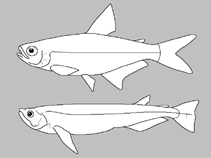
Classification / Noms
Noms communs | Synonymes | Catalog of Fishes(Genre, Espèce) | ITIS | CoL | WoRMS | Cloffa
>
Characiformes (Characins) >
Characidae (Characins; tetras) > Tetragonopterinae
Etymology: Tetragonopterus: Name from Greek words: 'Tetra' meaning four; 'gonia' meaning angle; 'pteron' for fin; referring to the evident tetragonal shape of the body (Ref. 124043); kuluene: Named for Rio Culuene (indigenous spelling), the type locality of this new speciesl; nun in apposition.
Environnement : milieu / zone climatique / profondeur / gamme de distribution
Écologie
; eau douce pélagique. Tropical
South America: Brazil.
Taille / Poids / Âge
Maturité: Lm ? range ? - ? cm
Max length : 6.4 cm SL mâle / non sexé; (Ref. 124043)
Description synthétique
Clés d'identification | Morphologie | Morphométrie
Rayons mous dorsaux (Total) : 9; Rayons mous anaux: 26 - 30; Vertèbres: 30 - 31. This species is distinguished from its congeners, except T. anostomus, by having only 1 (vs. 2) conspicuous humeral mark; differs from T. anostomus by having a terminal mouth (vs. subsuperior mouth); differs from T. anostomus, T. araguaiensis by the number of gill rakers of the first gill arch, lower 12-13 and upper 8-9, limbs (vs. 17-20 and 10-12 respectively); differs from all congeners, except T. anostomus, T. denticulatus, T. juruena, by having principal dentary teeth 5-6 (vs. 4) and with thinner and sharper teeth (vs. more robust teeth); differs from T. denticulatus by the numbe of scale rows between lateral line and dorsal-fin origin 6 (vs. 7); differs from T. argenteus by the number of predorsal scales 8 (vs. 11-17); differs from T. carvalhoi by the presence of a rounded dark mark on the caudal peduncle (vs. a lozenge-shaped dark mark); differs from T. rarus by the absence of dark longitudinal stripes on the trunk (vs. presence); differs from T. georgiae, T. rarus by the scale rows between lateral line and pelvic-fin origin 3.5 (vs. 4.5-5.5); differs from T. ommatus by the number of maxillary teeth 2-5 (vs. 8-7) and by having the mark centered on caudal peduncle (vs. mark limited to posterior portion of caudal peduncle) (Ref. 124043).
Cross section: compressed.
Cycle de vie et comportement reproducteur
Maturité | Reproduction | Frai | Œufs | Fécondité | Larves
Silva, G.S.C., B.F. Melo, C. Oliveira and R.C. Benine, 2016. Revision of the South American genus Tetragonopterus Cuvier, 1816 (Teleostei: Characidae) with description of four new species. Zootaxa 4200(1):1-46. (Ref. 124043)
Statut dans la liste rouge de l'IUCN (Ref. 130435: Version 2025-2 (Global))
Menace pour l'homme
Harmless
Utilisations par l'homme
Outils
Articles particuliers
Télécharger en XML
Sources Internet
Estimations basées sur des modèles
Indice de diversité phylogénétique (Réf.
82804): PD
50 = 0.5000 [Uniqueness, from 0.5 = low to 2.0 = high].
Bayesian length-weight: a=0.02570 (0.01066 - 0.06197), b=2.98 (2.79 - 3.17), in cm total length, based on LWR estimates for this Genus-body shape (Ref.
93245).
Niveau trophique (Réf.
69278): 3.4 ±0.4 se; based on size and trophs of closest relatives
Vulnérabilité de la pêche (Ref.
59153): Low vulnerability (10 of 100).
🛈