>
Gobiesociformes (Clingfishes) >
Gobiesocidae (Clingfishes and singleslits) > Lepadogastrinae
Etymology: Gouania: From Antoine Gouan, in Montpellier was the author of a "Historia piscium" (Ref. 45335); orientalis: Name from Latin word 'oriens' for 'east', the distribution range of the species. restricted to the oriental Mediterranean basin; an adjective in the nominative singular (Article 11.9.1.1., ICZN, 1999).
Eponymy: Dr Antoine Gouan (1733–1821) was a French naturalist, a pioneer of Linnaean taxonomy in France, who was born and lived in Montpellier. [...] (Ref. 128868), visit book page.
Milieu: milieu / Klimaatzone / Diepte / verspreidingsgebied
Ecologie
marien demersaal. Temperate
Mediterranean: Greece.
Grootte / Gewicht / Leeftijd
Maturiteit: Lm ? range ? - ? cm
Max length : 3.8 cm SL mannelijk / geslacht onbekend; (Ref. 123696)
Korte beschrijving
Determinatiesleutels | Morfologie | Morfometrie
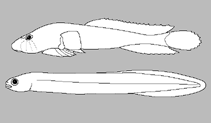
Wervels: 35 - 36. This species is distinguished from its congeners by the following set of characters: dorsal head profile straight from nape above eye to upper lip tip; posterior angle of jaws extending to between a vertical line drawn through anterior edge of eye and a vertical line drawn through anterior part of eye; infraorbital invagination vertical to posterior part of eye; posterior opercular edge w-shaped with two equally long tips; longitudinal infralateral and suborbital transversal rows of superficial neuromasts are in the well-defined deep groove; trunk cross-section behind pectoral fin base half oval with straight ventral side; body granules shallow and inconspicuous; upper attachment of gill membrane is opposite to 5th to 6th pectoral ray; pectoral rays 17-19; upper attachment of disc membrane attaching to base of pectoral fin at 16th-18th pectoral ray; principal caudal rays 10-11; head length 25.0-28.9% of SL; pectoral fin length 8.2-10.3% of SL; prepectoral distance 24.7-28.2% of SL; ventral adhesive disc length 14.9-19.0% SL; caudal-fin length 14.2-17.5% of SL; low number of vertebrae 35-36; pharyngeal jaws with small ceratobranchial 5, having a few hardly recognizable small conical teeth; nasal bones with inconspicuous frontal end; in life with star-like pigmentation around eyes, body colouration dark, sometimes marbled or with stripes (Ref. 123696).
Cross section: oval.
Levenscyclus en paargedrag
Maturiteit | Voortplanting | Paaien | Eieren | Fecunditeit | Larven
Wagner, M., M. Kovačic and S. Koblmüller, 2021. Unravelling the taxonomy of an interstitial fish radiation: Three new species of Gouania (Teleostei: Gobiesocidae) from the Mediterranean Sea and redescriptions of G. willdenowi and G. pigra. J. Fish Biol. 98(1):64-88. (Ref. 123696)
Status op de Rode Lijst van het IUCN (Ref. 130435: Version 2025-2 (Global))
Gevaar voor de mens
Harmless
Gebruik door de mens
Tools
Speciale rapporten
Download XML
Internetbronnen
Schattingen op basis van modellen
Fylogenetische diversiteitsindex (Ref.
82804): PD
50 = 0.5312 [Uniqueness, from 0.5 = low to 2.0 = high].
Bayesian length-weight: a=0.00513 (0.00200 - 0.01317), b=3.10 (2.88 - 3.32), in cm total length, based on LWR estimates for this (Sub)family-body shape (Ref.
93245).
Trofisch niveau (Ref.
69278): 3.1 ±0.5 se; based on size and trophs of closest relatives
Weerstandsvermogen (Ref.
120179): Hoog, minimale populatieverdubbelingstijd minder dan 15 maanden (Preliminary K or Fecundity.).
Kwetsbaarheid van de visserij (Ref.
59153): Low vulnerability (10 of 100).
🛈