Classification / Noms
Noms communs | Synonymes | Catalog of Fishes(Genre, Espèce) | ITIS | CoL | WoRMS | Cloffa
>
Gobiiformes (Gobies) >
Schindleriidae (Infantfishes)
Etymology: Schindleria: Named for ichthyologist Otto Schindler, 1906-1959 (Prof. Dr. Konrad Schindler, pers. comm Dec. 2017); multidentata: Name from Latin 'multus' for many, and 'dentatus' for toothed, referring to the high number of teeth on the tooth bearing elements of the oral jaws.
Eponymy: Otto Schindler (1906–1959) was an ichthyologist at Zoologische Staatssammlung München, Germany, where he was the first post-war Curator of Ichthyology (1949). [...] (Ref. 128868), visit book page.
Environnement : milieu / zone climatique / profondeur / gamme de distribution
Écologie
marin récifal. Tropical
South Pacific Ocean: French Polynesia (Tahiti).
Taille / Poids / Âge
Maturité: Lm ? range ? - ? cm
Max length : 1.7 cm SL mâle / non sexé; (Ref. 123103); 2.0 cm SL (female)
Description synthétique
Clés d'identification | Morphologie | Morphométrie
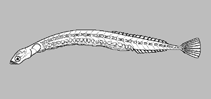
Rayons mous dorsaux (Total) : 19 - 21; Rayons mous anaux: 13 - 15; Vertèbres: 33 - 35. This species is distinguished by the following: body slender, elongated and not pigmented in preserved specimen; tail distinctly shorter than the abdomen; body depth at pectoral radial plate origin 4.1% of SL and at anal-fin origin 5.6% of SL; origin of dorsal fin distinctly anterior to origin of anal fin (long dorsal fin type), predorsal length 57.6 % of SL and preanal length 74.3 % of SL; tail length (without caudal fin) 29.8 % of SL; D 19-21; A 13-15; first anal-fin ray positioned below 9th-10th dorsal fn ray; premaxilla with about 40 closely spaced tiny teeth along entire ventral margin; teeth on dentary about 30 separated by a distinct gap (diastema) into two groups; myomeres 34-36; male urogenital papilla elongate, tube like, tapering towards tip; female urogenital papilla tiny and inconspicuous (Ref. 123103).
Cross section: oval.
Cycle de vie et comportement reproducteur
Maturité | Reproduction | Frai | Œufs | Fécondité | Larves
Ahnelt, H., 2020. A new species of Schindleria (Teleostei: Gobiidae) from Tahiti (French Polynesia) with a unique lower jaw dentition. Vertebrate Zoology 70(2):195-205. (Ref. 123103)
Statut dans la liste rouge de l'IUCN (Ref. 130435: Version 2025-2 (Global))
Menace pour l'homme
Harmless
Utilisations par l'homme
Pêcheries: sans intérêt
Outils
Articles particuliers
Télécharger en XML
Sources Internet
Estimations basées sur des modèles
Indice de diversité phylogénétique (Réf.
82804): PD
50 = 0.5005 [Uniqueness, from 0.5 = low to 2.0 = high].
Bayesian length-weight: a=0.00389 (0.00180 - 0.00842), b=3.12 (2.94 - 3.30), in cm total length, based on all LWR estimates for this body shape (Ref.
93245).
Niveau trophique (Réf.
69278): 3.0 ±0.4 se; based on size and trophs of closest relatives
Vulnérabilité de la pêche (Ref.
59153): Low vulnerability (10 of 100).
🛈