This website uses cookies to enhance your browsing experience and ensure the functionality of our site. For more detailed information about the types of cookies we use and how we protect your privacy, please visit our Privacy Information page.
×
Cookie Settings
This website uses different types of cookies to enhance your experience. Please select your preferences below:
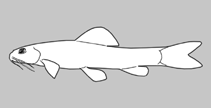
No image available for this species; drawing shows typical species in Nemacheilidae.
分类 / 名称 俗名 | 同种异名 | Catalog of Fishes(属, 种) | ITIS | CoL | WoRMS | Cloffa
Teleostei > Cypriniformes (Carps) > Nemacheilidae (Brook loaches)
Etymology: Homatula:Greek, homos, homoios = similar + Greek, atylos, atylotos = without callosities; anteridorsalis:Name from Latin 'anteri' meaning 'in front' and 'dorsalis' for dorsal fin, referring to the more anterior origin of dorsal- and pelvic-fins than in other species of Homatula.
This species is distinguished from its congeners by the following set of characters: with bars on flank across lateral line more than or equal to 25 (vs. less than or equal to 20 in H. acuticephala, H. erhaiensis); bars on flank vertical along lateral line (vs. none in H. nigra); no free protrusions between the pelvic fins (vs. pair of free protrusions in H. pycnolepis); gill opening is smaller, upper angle level with lower edge of eye (vs. opening larger and with upper angle aligned with middle point of eye in H. acuticephala, H. anguillioides, H. coccinocola, H. erhaiensis, H. pycnolepis); with pelvic axillary lobe (vs. none in H. anguillioides, H. acuticephala); marked notch on lower jaw (vs. lower jaw spoon-shaped and no notch in H. erhaiensis, H. wuliangensis); dorsal-fin base is shorter than longest branched dorsal-fin ray (vs. longer than longest branched dorsal-fin ray in H. acuticephala, H. anguillioides, H. cryptoclathrata, H. erhaiensis, H. wuliangensis); dorsal and pelvic fins are located anteriorly, predorsal length 44.4% SL (42.8-46.3%), prepelvic length 45% SL (43.3-46.7 %) (vs. predorsal length 47.7% SL (45.7-49.6 %), prepelvic length 48.7% SL (47.0-49.9 %) in all congeners of densely-scaled group of Homatula (Ref. 121600). Cross section: circular.
Inhabits flowing and clear stream environments and dwells on the bottom, shuttling back and forth among rocks and gravel. An omnivorous species, mainly feeding on algae attached to rocks, organic residues, and small aquatic insects. It inhabits flowing and clear stream environments and dwells on the bottom, shuttling back and forth among rocks and gravel (Ref. 121600).
Li, X., X.-J. Che and W. Zhou, 2019. Loaches of Homatula (Teleostei: Nemacheilidae) from the upper Salween River in Yunnan, China with description of three new species. Zootaxa 4711(2):330-348. (Ref. 121600)
世界自然保护联盟红皮书 (Ref. 130435: Version 2025-2 (Global))
系统发育多样性指数 (参考文献 82804): PD50 = 0.5000 [Uniqueness, from 0.5 = low to 2.0 = high].
Bayesian length-weight: a=0.00724 (0.00352 - 0.01491), b=3.01 (2.84 - 3.18), in cm total length, based on LWR estimates for this (Sub)family-body shape (Ref. 93245).
营养阶层 (参考文献 69278): 2.7 ±0.3 se; based on size and trophs of closest relatives
回复力 (参考文献 120179): 中等的, 族群倍增时间最少 1.4 - 4.4年 (Preliminary K or Fecundity.).
渔业脆弱性 (Ref. 59153): Low vulnerability (10 of 100). 🛈