Klassifizierung / Names
Namen | Synonyme | Catalog of Fishes(Gattung, Arten) | ITIS | CoL | WoRMS | Cloffa
>
Cypriniformes (Carps) >
Nemacheilidae (Brook loaches)
Etymology: Homatula: Greek, homos, homoios = similar + Greek, atylos, atylotos = without callosities; cryptoclathrata: Name from Latin, combination of 'crypto' meaning cryptic or hidden and 'clathratus' for barred, referring to the indistinct pattern of bars on the flank in front of the dorsal-fin; an adjective.
origin.
Umwelt: Milieu / Klimazone / Tiefenbereich / Verbreitungsgebiet
Ökologie
; süßwasser demersal. Subtropical
Asia: China.
Größe / Gewicht / Alter
Geschlechtsreife: Lm ? range ? - ? cm
Max length : 13.8 cm SL Männchen/unbestimmt; (Ref. 121600)
Kurzbeschreibung
Bestimmungsschlüssel | Morphologie | Morphometrie
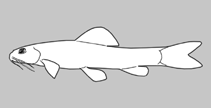
This species is distinguished from its congeners by the following set of characters: sides with bars across lateral line equal to or greater than 25 (vs. equal or less than 20 in H. acuticephala, H. erhaiensis); bars on sides vertical along lateral line (vs. no marks H.
Nigra); without free protrusions between the pelvic fins (vs. a pair of free protrusions between the pelvic fins in H. pycnolepis); gill opening smaller, with upper angle level with lower edge of eye (vs. larger gill opening and its upper angle aligned with middle point of eye in H. anguillioides, H. acuticephala, H. coccinocola, H. erhaiensis, H. pycnolepis); with pelvic axillary lobe (vs. none in H. acuticephala, H. anguillioides); marked notch on lower jaw (vs. lower jaw spoon-shaped, no notch in H. erhaiensis, H. wuliangensis); dorsal-fin base is longer than length of longest branched dorsal-fin ray (vs. shorter than longest branched dorsal-fin ray in H. anteridorsalis, H. nigra, H. pycnolepis); bars on anterior flank crowded together, faintly visible in fresh specimens (vs. distinct in H. acuticephala, H. anguillioides, H. anteridorsalis, H. change, H. coccinocola, H. erhaiensis, H. pycnolepis, H. wuliangensis) (Ref. 121600).
Cross section: circular.
Inhabits flowing and clear stream environments, dwells on the stream bottom, shuttling back and forth among rocks and gravel. An omnivorous species, mainly feeding on algae attached to rocks, organic residues, and small aquatic insects (Ref. 121600)..
Lebenszyklus und Paarungsverhalten
Geschlechtsreife | Fortpflanzung | Ablaichen | Eier | Fruchtbarkeit | Larven
Li, X., X.-J. Che and W. Zhou, 2019. Loaches of Homatula (Teleostei: Nemacheilidae) from the upper Salween River in Yunnan, China with description of three new species. Zootaxa 4711(2):330-348. (Ref. 121600)
IUCN Rote Liste Status (Ref. 130435: Version 2025-2 (Global))
Bedrohung für Menschen
Harmless
Nutzung durch Menschen
Tools
Zusatzinformationen
Download XML
Internet Quellen
Schätzungen auf der Grundlage von Modellen
Phylogenetischer Diversitätsindex (Ref.
82804): PD
50 = 0.5000 [Uniqueness, from 0.5 = low to 2.0 = high].
Bayesian length-weight: a=0.00724 (0.00352 - 0.01491), b=3.01 (2.84 - 3.18), in cm total length, based on LWR estimates for this (Sub)family-body shape (Ref.
93245).
Trophische Ebene (Ref.
69278): 2.7 ±0.3 se; based on size and trophs of closest relatives
Widerstandsfähigkeit (Ref.
120179): mittel, Verdopplung der Population dauert 1,4 - 4,4 Jahre. (Preliminary K or Fecundity.).
Anfälligkeit der Fischerei (Ref.
59153): Low vulnerability (10 of 100).
🛈