Elasmobranchii (haaien en roggen) (sharks and rays) >
Rhinopristiformes (Shovelnose rays) >
Rhinobatidae (Guitarfishes)
Etymology: stehmanni: Named for Dr. Matthias F.W. Stehmann for his invaluable contributions to chondrichthyan taxonomy, particularly with respect to skates.
Eponymy: Dr Matthias F W Stehmann (d: 1943) is a German ichthyologist whose university career at Kiel University (1962–1969) resulted in degrees covering marine sciences, zoology and limnology and culminated with a doctorate in marine sciences. [...] (Ref. 128868), visit book page.
Milieu: milieu / Klimaatzone / Diepte / verspreidingsgebied
Ecologie
marien demersaal; diepte 36 - 43 m (Ref. 124452). Tropical
Western Indian Ocean: off Socotra Is. (restricted).
Grootte / Gewicht / Leeftijd
Maturiteit: Lm ? range ? - 37.8 cm
Max length : 62.2 cm TL mannelijk / geslacht onbekend; (Ref. 124452); 60.2 cm TL (female)
Korte beschrijving
Determinatiesleutels | Morfologie | Morfometrie
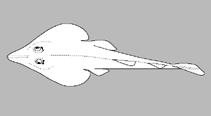
This species is distinguished by the following set of characters: dorsal surface is smooth, no prominent thorns or tubercles, except for the slightly enlarged granular denticles partially around orbital rims and rather regularly distributed along midline from nape to or to somewhat anterior to first dorsal-fin origin, none between dorsal fins and upper caudal fin; the snout semi-translucent with a few, somewhat elongated bluish-gray spots only, giving it a very reduced stripe-nosed appearance, patterning with small bluish-gray circular spots generally few and confined to symmetrical patterns on snout tip, the posterior pectoral-fin margins, a pair of tiny spots on midbody behind occipital joint, and few spots on posterior pelvic-fin margins; brown spots indistinct on body and dorsal and caudal fins; ventral surface is white except for a blackish blotch and two tiny black spots on ventral snout tip in smallest juvenile paratype; nasal lamellae 43-48; upper jaw tooth row count ca. 64-78; post-synarcual centra 181-186; total vertebral segments 194-200; total pectoral skeleton radials 63-67 (Ref. 124452).
Cross section: flattened.
Occurs in coastal waters. Size range from 20.8 - 62.2 cm TL, males at size 37.8 cm TL is considered very early subadult (apparently start to mature around this size) and juvenile at 20.8 cm TL; while females at 59.4 and 60.2 cm TL are presumed to be adult (Ref. 124452).
Levenscyclus en paargedrag
Maturiteit | Voortplanting | Paaien | Eieren | Fecunditeit | Larven
Weigmann, S., D.A. Ebert, B. Séret, 2021. Resolution of the Acroteriobatus leucospilus species complex, with a redescription of A. leucospilus (Norman, 1926) and descriptions of two new western Indian Ocean species of Acroteriobatus (Rhinopristiformes, Rhinobatidae). Marine Biodiversity (2021):51:58. (Ref. 124452)
Status op de Rode Lijst van het IUCN (Ref. 130435: Version 2025-2 (Global))
Gevaar voor de mens
Harmless
Gebruik door de mens
Tools
Speciale rapporten
Download XML
Internetbronnen
Schattingen op basis van modellen
Fylogenetische diversiteitsindex (Ref.
82804): PD
50 = 0.5010 [Uniqueness, from 0.5 = low to 2.0 = high].
Bayesian length-weight: a=0.00295 (0.00150 - 0.00581), b=3.13 (2.96 - 3.30), in cm total length, based on LWR estimates for this (Sub)family-body shape (Ref.
93245).
Trofisch niveau (Ref.
69278): 3.5 ±0.5 se; based on size and trophs of closest relatives
Weerstandsvermogen (Ref.
120179): laag, minimale populatieverdubbelingstijd 4,5-14 jaar (Preliminary low fecundity).
Kwetsbaarheid van de visserij (Ref.
59153): Moderate vulnerability (45 of 100).
🛈