Klassifizierung / Names
Namen | Synonyme | Catalog of Fishes(Gattung, Arten) | ITIS | CoL | WoRMS | Cloffa
>
Perciformes/Uranoscopoidei (Sand dwellers) >
Ammodytidae (Sand lances)
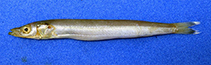
Etymology: Bleekeria: He researched the fishes from India and Malaysia, 1862-1878 (Ref. 45335); albicauda: Name from Latin words 'albus' for white and 'cauda' for tail; reeerring to its distinctive white blotches on the tips of the caudal fin (unique among congeners).
Eponymy: Dr Pieter Bleeker (1819–1878) was an ichthyologist and army surgeon commissioned (1841) by the Dutch East India Company. [...] (Ref. 128868), visit book page.
Umwelt: Milieu / Klimazone / Tiefenbereich / Verbreitungsgebiet
Ökologie
seewasser benthopelagisch; tiefenbereich ? - 77 m (Ref. 123825). Tropical
Northeastern Indian Ocean: Andaman Sea, Myanmar.
Größe / Gewicht / Alter
Geschlechtsreife: Lm ? range ? - ? cm
Max length : 11.4 cm TL Männchen/unbestimmt; (Ref. 123825)
Kurzbeschreibung
Bestimmungsschlüssel | Morphologie | Morphometrie
Rückenflossenweichstrahlen (insgesamt) : 40 - 41; Afterflossenweichstrahlen: 15 - 16; Wirbelzahl: 53 - 55. This species is distinguished by the following characters: D 40-41; A 15-16; pectoral-fin rays ii,11,ii; pelvic-fin rays 5; lateral-line scales 106-107; scale rows between the dorsal-fin origin and lateral line 4; gill rakers 6-7+23-24; vertebrae 28-29+25-26; teeth in jaws absent; scales on central part of body clearly shorter than their height; pectoral-fin length 8.0-8.5 in SL; pelvic-fin length 21.3-23.3 in SL; head length 3.4-3.5 in SL; body depth at dorsal-fin origin 8.9-9.3 in SL. Colouration: when fresh, body greyish above, paler below; pectoral fins are pale yellowish; caudal fin brownish yellow basally, blackish medially with tips of upper and lower lobes milky white (Ref. 123825).
Cross section: oval.
Lebenszyklus und Paarungsverhalten
Geschlechtsreife | Fortpflanzung | Ablaichen | Eier | Fruchtbarkeit | Larven
Psomadakis, P.N., T. Yoshinaga, Z.Z. Wah and H. Ida, 2021. Description of two new species of sandlances, genus Bleekeria (Perciformes, Ammodytidae) from the Andaman Sea (northeastern Indian Ocean). Zootaxa 4903(3):419-429. (Ref. 123825)
IUCN Rote Liste Status (Ref. 130435: Version 2025-2 (Global))
Bedrohung für Menschen
Harmless
Nutzung durch Menschen
Tools
Zusatzinformationen
Download XML
Internet Quellen
Schätzungen auf der Grundlage von Modellen
Phylogenetischer Diversitätsindex (Ref.
82804): PD
50 = 0.5039 [Uniqueness, from 0.5 = low to 2.0 = high].
Bayesian length-weight: a=0.00324 (0.00142 - 0.00739), b=3.07 (2.88 - 3.26), in cm total length, based on LWR estimates for this (Sub)family-body shape (Ref.
93245).
Trophische Ebene (Ref.
69278): 3.2 ±0.4 se; based on size and trophs of closest relatives
Widerstandsfähigkeit (Ref.
120179): hoch, Verdopplung der Population dauert weniger als 15 Monate. (Preliminary K or Fecundity.).
Anfälligkeit der Fischerei (Ref.
59153): Low vulnerability (10 of 100).
🛈