>
Perciformes/Gasterosteoidei (Sticklebacks) >
Gasterosteidae (Sticklebacks and tubesnouts)
Etymology: Pungitius: Name meaning one that pricks; modestus: Named for its moderate behaviour where adults do not fight each other except during the reproductive season.
Entorno: milieu / zona climática / rango de profundidad / gama de distribución
Ecología
; agua dulce bentopelágico. Subtropical
Asia: Japan.
Tamaño / Peso / Edad
Madurez: Lm ? range ? - ? cm
Max length : 5.7 cm SL macho / no sexado; (Ref. 124673)
Descripción breve
Claves de identificación | Morfología | Morfometría
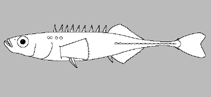
Espinas dorsales (total) : 8 - 9; Radios blandos dorsales (total) : 9 - 11; Espinas anales: 1; Radios blandos anales: 7 - 9. This species is distinguished by the following characters: D VIII-IX, 9-11; pectoral-fin rays 10; small unconnected lateral plates 30-32, running from just behind the dorsal end of the gill opening to the caudal peduncle; caudal peduncle with keel; dorsal-fin spine inclining atlernately to left and right of the mid-line; short spines on dorsal, 3.6% SL (2.7-4.9), anal 5.0% SL (4.1-6.0) and pelvic 5.0% SL (4.1-6.0) ; short base of spiny dorsal fin 28.7% SL (26.5-29.8); the first dorsal-fin spine is above slightly behind the pectoral-fin base; anal spine below the first (1st-3rd) dorsal-fin ray; ascending process of the pelvis is relatively developed and extending dorsally tot eh level of the dorsal-most actinost; antero-ventral process of ectocoracoid present, the left and right articulating with each other at the anterior end; membranes of dorsal-fin spines are colored dark brown with many pigments (Ref. 124673).
Cross section: compressed.
Occurs in small streams and ponds that are refreshed by abiundant cold spring water from the bottom with temperatures ca. 16°C year-round. This fish tends to hide in water grasses and usually remains still, suspended just above the bottom. The adults feed mainly on amphipods (e.g. Jesogammarus jesoensis) that are extremely abundant in the type locality. The larvae, on the other hand, feed on tubificids, while 30-day old juveniles on chrironomids and copepods. Breeding season peaks in May, with courtship behavior occurring at night, but may also be observed in the daytime. Reported observation stated that usually, females spawn at night between 21:00 and dawn (Ref. 124673).
Ciclo vital y comportamiento de apareamiento
Madurez | Reproducción | Puesta | Huevos | Fecundidad | Larva
Matsumoto, T., K. Matsuura and N. Hanzawa, 2021. A new species of nine-spined stickleback, Pungitius modestus (Gasterosteiformes, Gasterosteidae), from northern Honshu, Japan. Zootaxa 5005(1):1-20. (Ref. 124673)
Situación en la Lista Roja de la UICN (Ref. 130435: Version 2025-2 (Global))
Amenaza para el ser humano
Harmless
Usos humanos
Pesquerías: sin interés
Herramientas
Informes especiales
Descargar XML
Fuentes de Internet
Estimaciones basadas en modelos
Índice de diversidad filogenética (Referencia
82804): PD
50 = 0.5005 [Uniqueness, from 0.5 = low to 2.0 = high].
Bayesian length-weight: a=0.00468 (0.00199 - 0.01098), b=3.04 (2.83 - 3.25), in cm total length, based on LWR estimates for this (Sub)family-body shape (Ref.
93245).
Nivel trófico (Referencia
69278): 3.4 ±0.2 se; based on size and trophs of closest relatives
Resiliencia (Referencia
120179): Alto, población duplicada en un tiempo mínimo inferior a 15 meses (Preliminary K or Fecundity.).
Vulnerabilidad pesquera (Ref.
59153): Low vulnerability (10 of 100).
🛈