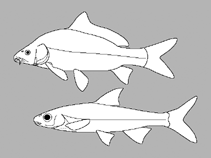
分类 / 名称
俗名 | 同种异名 | Catalog of Fishes(属, 种) | ITIS | CoL | WoRMS | Cloffa
Teleostei >
Cypriniformes (Carps) >
Cyprinidae (Minnows or carps) > Barbinae
Etymology: Barbus: Latin, barbus = barbel (Ref. 45335); samniticus: Named for Samnites, ancient Italic people who settled in the type locality.
Eponymy: Sir Charles Alfred Payton (1843–1926) was a British adventurer, writer, fisherman and diplomat who was British Consul to Morocco, where this barb is found. [...] (Ref. 128868), visit book page.
环境:氛围 / 气候带 / 深度上下限 / 分布范围
生态学
; 淡水 底中水层性.
分布
领土 | FAO区域 | 生态系 | 标本纪录 | 分布图 | 简介 | Faunafri
Europe: Italy.
大小 / 重量 / 年龄
成熟度: Lm ? range ? - ? cm
Max length : 18.8 cm SL 雄鱼/尚未辨别雌雄; (Ref. 123793)
简单描述
检索表 | 型态特徵 | 形态测量图
This species is distinguished by the following characters: last unbranched dorsal-fin ray weakly ossified; superior margin of the dorsal fin is straight or slightly concave like other Italian fluviolacustrine barbels (some profile slightly convex); numerous small irregular-shaped black or dark-brown dots, smaller than scales that often form large, black or dark-brown spots on the back and flanks in juveniles and adults and this pigmentation is more evident in specimens living in clear water, whereas it tends to disappear in turbid environments; differs from all the other species by its greatest maximum height 20.4-25.1% SL (vs. 18.8%-24.9% SL in B. fucini, 19.0%-22.7% SL in B. tyberinus, 17.9%-22.7% SL in B. plebejus); differs from B. fucini by the shorter pre-orbital distance 8.2%-9.7% SL (vs. 7.9%-11.0% SL); differs from B. tyberinus and B. plebejus by having longer pectoral fins 17.1% - 20.6% (vs. 16.7%-19.8% and 15.7%-20.4% SL, respectively); longer ventral fin 12.4%-16.8% (vs. 11.0%-15.7% and 11.6%-15.3% SL) and caudal fins 12.5%16.4% (vs. 12.1%-14.7% and 12.1%-15.1% SL); differs from B. tyberinus in that it has longer lobes of the caudal fin upper: 21.2%-26.2% (vs. 19.1%-23.7% SL) and lower:19.8%-26.1% (vs. 19.5%-23.4% SL), a greater dorsal fin 14.6%-19.0% (vs. 13.7%-16.3% SL), a major presence of pigmentation and dots on scales and fins and a different dominant (orange) colour of the anal, dorsal and ventral fins; differs from B. plebejus by having fewer scales on 51-67 (vs. 58-71), above 10-13 (vs. 11-15) and under 7-9 (vs. 8-11) the lateral line, greater minimum height 10.2%-12.5% (vs. 9.3%-11.1%% SL), smaller fork depth 8.8% - 11.3% (vs. 9.1%-12.5% SL) and greater amount of body spots (Ref. 123793),
Cross section: compressed.
This species populates intermediate and hilly stretches of Apennine rivers together with other Italian species typical of the barbel zone: Sarmarutilus rubilio, Telestes muticellus and Squalius squalus (Ref. 123793).
生命周期和交配行为
成熟度 | 繁殖 | 产卵场 | 卵 | 孕卵数 | 仔鱼
Lorenzoni, M., A. Carosi, S. Quadroni, V. De Santis, I. Vanetti, G.B. Delmastro and S. Zaccara, 2021. Cryptic diversity within endemic Italian barbels: revalidation and description of new Barbus species (Teleostei: Cyprinidae). J. Fish Biol. 98(5):1433-1449. (Ref. 123793)
世界自然保护联盟红皮书 (Ref. 130435: Version 2025-2 (Global))
易受伤害 (VU) (B1ab(iii)); Date assessed: 19 October 2023
人类利用
工具
特别资料
下载 XML
网络资源
基于模型的估算
系统发育多样性指数 (参考文献
82804): PD
50 = 0.5000 [Uniqueness, from 0.5 = low to 2.0 = high].
Bayesian length-weight: a=0.00794 (0.00367 - 0.01719), b=3.05 (2.88 - 3.22), in cm total length, based on LWR estimates for this Genus-body shape (Ref.
93245).
营养阶层 (参考文献
69278): 3.1 ±0.4 se; based on size and trophs of closest relatives
回复力 (参考文献
120179): 中等的, 族群倍增时间最少 1.4 - 4.4年 (Preliminary K or Fecundity.).
渔业脆弱性 (Ref.
59153): Low vulnerability (13 of 100).
🛈