Classification / Noms
Noms communs | Synonymes | Catalog of Fishes(Genre, Espèce) | ITIS | CoL | WoRMS | Cloffa
>
Perciformes/Zoarcoidei (Eelpouts and pricklebacks) >
Zoarcidae (Eelpouts) > Gymnelinae
Etymology: Melanostigma: Greek, melan, -anos = black + Greek, stigma = signal (Ref. 45335); bellingshauseni: Named for Faddei Faddeevich Bellingshausen (1778-1852), the famous Russian naval navigator, commander of the Russian around-the-world naval expedition in 1819-1821. During that expedition, 200 year ago, on January 16 (old style), 1820 at latitude 69°21'28" S, 2°14'50" W the continent of Antarctica was discovered.
Environnement : milieu / zone climatique / profondeur / gamme de distribution
Écologie
marin bathydémersal; profondeur 1000 - 1010 m (Ref. 123831). Deep-water
Southern Indian Ocean: Kerguelen Plateau.
Taille / Poids / Âge
Maturité: Lm ? range ? - ? cm
Max length : 19.4 cm TL mâle / non sexé; (Ref. 123831)
Description synthétique
Clés d'identification | Morphologie | Morphométrie
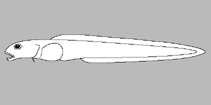
Vertèbres: 86 - 91. This species is distinguished by the following characters: supratemporal commissure complete (full), without interruptions and losses of segments; no coronal commissure; with pore in the temporal canal; body lateral line with three series of neuromasts (predorsal, dorsolateral, and mediolateral); gill rakers on the first branchial arch 27 (23-27), of which 13 (10-13) in external row; 14 (13-16) in internal row; pectoral-fin rays 8; vertebrae 87 (86-91) including 21 (21-23) abdominal and 66 (68-71) caudal vertebrae; maxilla length 7.4 (6.5-7.8)% SL; upper lip coalesce with snout; abdominal vertebrae is slightly asymmetrical; length of anterior
part of the center of vertebrae (in area of fifth to eighth vertebrae) 70-92% of length of its posterior part; body and head including snout tip, nostril tubes, and oral cavity light; tail with dark stripe at tips of dorsal, anal, and caudal fins (Ref. 123831).
Cross section: oval.
Cycle de vie et comportement reproducteur
Maturité | Reproduction | Frai | Œufs | Fécondité | Larves
Orlovskaya, M.V. and A.V. Balushkin, 2020. Melanostigma bellingshauseni sp. n. (Zoarcidae): a new pelagic eelpout from large depths in the Central Part of the Kerguelen Plateau (Southern Ocean). J. Ichthyol. 60(6):900-908. (Ref. 123831)
Statut dans la liste rouge de l'IUCN (Ref. 130435: Version 2025-2 (Global))
Menace pour l'homme
Harmless
Utilisations par l'homme
Outils
Articles particuliers
Télécharger en XML
Sources Internet
Estimations basées sur des modèles
Indice de diversité phylogénétique (Réf.
82804): PD
50 = 0.5020 [Uniqueness, from 0.5 = low to 2.0 = high].
Bayesian length-weight: a=0.00324 (0.00135 - 0.00773), b=3.15 (2.94 - 3.36), in cm total length, based on LWR estimates for this (Sub)family-body shape (Ref.
93245).
Niveau trophique (Réf.
69278): 3.2 ±0.4 se; based on size and trophs of closest relatives
Résilience (Réf.
120179): Milieu, temps minimum de doublement de population : 1,4 à 4,4 années (Preliminary K or Fecundity.).
Vulnérabilité de la pêche (Ref.
59153): Low vulnerability (10 of 100).
🛈