इलाज़मौबरांकी (शारक और रेज़) (sharks and rays) >
Rajiformes (Skates and rays) >
Rajidae (Skates)
Etymology: Amblyraja: Greek, amblys = darkness + Latin, raja, -ae = ray (Raja sp.) (Ref. 45335).
Eponymy: This is a toponym referring to the fact that the holotype was caught in the coastal waters of South Georgia and was named after that island. (Ref. 128868), visit book page.
More on author: Norman.
पर्यावरण: पर्यावरण / जलवायु क्षेत्र / गहराई सीमा / वितरण सीमा
पारिस्थितिकी
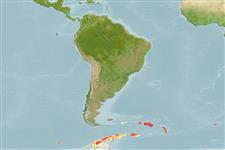
समुद्री बाथीड़िमरसल; गहराई सीमा 20 - 350 m (Ref. 58839). Deep-water; 43°S - 74°S, 48°E - 23°W (Ref. 114953)
Southeast Pacific: Chile (Ref. 27540). Southern Ocean: around South Georgia Island and on the ridge westward towards Black Rocks. Occasionally seen on the Scotia Ridge.
आकार / वज़न / आयु
परिपक्व अवधि: Lm ? range ? - ? cm
Max length : 115 cm TL पुल्लिंग / अलिंग; (Ref. 114953)
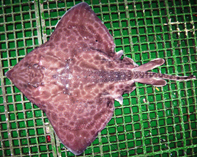
Found on continental and insular shelves, as well as upper slopes. Feeds mainly on small benthic invertebrates (Ref. 114953). Oviparous (Ref. 205). Reaches maturity at 80-90 cm TL; birth size at ca. 20 cm TL (Ref. 114953). Distinct pairing with embrace. Young may tend to follow large objects, such as their mother (Ref. 205). Eggs are oblong capsules with stiff pointed horns at the corners deposited in sandy or muddy flats (Ref. 205). Egg capsule measures 116.5 mm long and 80.0 mm wide (Ref. 41249). Utilized as fishmeal and possibly not utilized for human consumption due to extreme roughness of its squamation (Ref. 5159).
जीवन चक्र और संभोग व्यवहार
परिपक्व अवधि | पुनरुत्पत्ति | मछलीऔ का अंडे देना | अंडे | उपजाऊपन | लार्वा
Oviparous, paired eggs are laid. Embryos feed solely on yolk (Ref. 50449). Distinct pairing with embrace. Young may tend to follow large objects, such as their mother (Ref. 205). Eggs have horn-like projections on the shell (Ref. 205).
McEachran, J.D. and K.A. Dunn, 1998. Phylogenetic analysis of skates, a morphologically conservative clade of elasmobranchs (Chondrichthyes: Rajidae). Copeia 1998(2):271-290. (Ref. 27314)
आईयूसीएन रेड लिस्ट स्थिति (Ref. 130435: Version 2025-2 (Global))
मनुष्यों के लिए ख़तरा
Harmless
मानव उपयोग
मात्स्यिकी: निर्वाह मात्स्यिकी
साधन
विशेष रिपोर्ट
XML डाउनलोड करें
इंटरनेट स्रोत
मॉडल पर आधारित अनुमान
पसंदीदा तापमान (संदर्भ
123201): -1.4 - 0.5, mean -0.6 °C (based on 28 cells).
जातिवृति विविधता सूचकांक (संदर्भ
82804): PD
50 = 0.5039 [Uniqueness, from 0.5 = low to 2.0 = high].
Bayesian length-weight: a=0.00302 (0.00141 - 0.00645), b=3.24 (3.07 - 3.41), in cm total length, based on LWR estimates for this (Sub)family-body shape (Ref.
93245).
ट्रॉफिक स्तर (संदर्भ
69278): 4.2 ±0.3 se; based on size and trophs of closest relatives
लौटाव (संदर्भ
120179): निम्न, न्यूनतम जनसंख्या दुगनी होने का समय 4.5 - 14 वर्ष। (Assuming tm>5).
मछली पकड़ने की भेद्यता (Ref.
59153): High to very high vulnerability (69 of 100).
🛈
जलवायु भेद्यता (Ref.
125649): Moderate vulnerability (38 of 100).
🛈
पोषक तत्व (Ref.
124155): Calcium = 3.68 [0.60, 74.79] mg/100g; Iron = 0.312 [0.029, 4.166] mg/100g; Protein = 15.5 [13.4, 17.5] %; Omega3 = 0.393 [0.157, 0.959] g/100g; Selenium = 13.2 [2.4, 63.8] μg/100g; VitaminA = 6.56 [0.48, 84.64] μg/100g; Zinc = 0.219 [0.014, 2.548] mg/100g (wet weight);