Classification / Noms
Noms communs | Synonymes | Catalog of Fishes(Genre, Espèce) | ITIS | CoL | WoRMS | Cloffa
>
Atheriniformes (Silversides) >
Melanotaeniidae (Rainbowfishes, blue eyes)
Etymology: Melanotaenia: Greek, melan, -anos = black + latin, taenia = stripe (Ref. 45335); sneideri: Named for Richard Sneider, whom, together with Max Ammer planned and executed the 2013 Kumawa Mountains Expedition and who discovered the species, photographed and filmed it, and, with Obed Holago, first collected the type specimens.
Eponymy: Dr Richard Sneider (d: 1960) is a fish hobbyist and aquarist who is Global Chair (2013) of the IUCN Freshwater Fish Specialist Group. [...] (Ref. 128868), visit book page.
Environnement : milieu / zone climatique / profondeur / gamme de distribution
Écologie
; eau douce pélagique; profondeur 0 - 1 m (Ref. 95068). Tropical
Asia: Indonesia.
Taille / Poids / Âge
Maturité: Lm ? range ? - ? cm
Max length : 8.0 cm SL mâle / non sexé; (Ref. 95068); 8.0 cm SL (female)
Description synthétique
Clés d'identification | Morphologie | Morphométrie
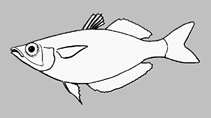
Épines dorsales (Total) : 4 - 7; Rayons mous dorsaux (Total) : 13 - 14; Épines anales: 1; Rayons mous anaux: 23 - 28. This species is distinguished by the following set of characters: D IV to VI-I,13-14 (usually V-I,13); A I,23-28 (most frequently 24); pectoral rays 13-15 (usually 14); lateral scales 34-36 (usually 35), predorsal scales 17-18; cheek scales 14-18 (x = 15.6); circumpeduncular scales 15-16; total gill rakers on first arch 18-20 (usually 18-19); no vomerine teeth or if present, as an inconspicuous rudimentary patch; head length 3.6-4.0 18 (x = 3.8) in SL; depth of caudal peduncle 2.3-2.8 (x = 2.5) in HL; maximum body depth of male (80.1 mm SL) 42.3 % SL. Colour in life of adult male generally bright red with bluish head, mainly dark brown to blackish dorsal, anal, and pelvic fins, and pinkish orange caudal fin (Ref. 95068).
Cross section: compressed.
The type locality lies at an altitude of 1,050 m and consists of a small ephemeral lake basin, approximately 1000 m long and 600 m wide. During dry periods, it consists of small creek that emerges from limestone rocks on the edge of the basin and flows for 500-600 m before draining underground. The maximum width of this remarkably clear creek varies from about 1-2 m, with a maximum depth of 30-50 cm, and average depth of about 10-20 cm. Late early March 2013, most fish, particularly large adults, were concentrated in rocky pools near the end of the creek, just before it disappeared into the ground. But conditions had changed dramatically due to heavy rainfall during a second visit near the end of March where the creek was then inundated, forming a small lake and consequently, the fish is more widely dispersed (Ref. 95068).
Cycle de vie et comportement reproducteur
Maturité | Reproduction | Frai | Œufs | Fécondité | Larves
Allen, G.R. and R.K. Hadiaty, 2013. Melanotaenia sneideri, a new species of rainbowfish (Melanotaeniidae), from West Papua Province, Indonesia. aqua, Int. J. Ichthyol. 19(3):137-146. (Ref. 95068)
Statut dans la liste rouge de l'IUCN (Ref. 130435: Version 2025-2 (Global))
Menace pour l'homme
Harmless
Utilisations par l'homme
Pêcheries: d'intérêt potentiel; Aquarium: potentiel
Outils
Articles particuliers
Télécharger en XML
Sources Internet
Estimations basées sur des modèles
Indice de diversité phylogénétique (Réf.
82804): PD
50 = 0.5000 [Uniqueness, from 0.5 = low to 2.0 = high].
Bayesian length-weight: a=0.01995 (0.00906 - 0.04395), b=3.01 (2.83 - 3.19), in cm total length, based on all LWR estimates for this body shape (Ref.
93245).
Niveau trophique (Réf.
69278): 2.9 ±0.4 se; based on size and trophs of closest relatives
Résilience (Réf.
120179): Milieu, temps minimum de doublement de population : 1,4 à 4,4 années (Preliminary K or Fecundity.).
Vulnérabilité de la pêche (Ref.
59153): Low vulnerability (10 of 100).
🛈