Klassifizierung / Names
Namen | Synonyme | Catalog of Fishes(Gattung, Arten) | ITIS | CoL | WoRMS | Cloffa
>
Syngnathiformes (Pipefishes and seahorses) >
Syngnathidae (Pipefishes and seahorses) > Syngnathinae
Etymology: Cylix: Name from Greek 'kylix' for cup or chalice, referring to the cup�like crest present on the head.
Umwelt: Milieu / Klimazone / Tiefenbereich / Verbreitungsgebiet
Ökologie
seewasser riff-verbunden; tiefenbereich 14 - 18 m (Ref. 125308). Tropical
Southwest Pacific: New Zealand.
Größe / Gewicht / Alter
Geschlechtsreife: Lm ? range ? - ? cm
Max length : 5.6 cm SL Männchen/unbestimmt; (Ref. 125308); 3.6 cm SL (female)
Kurzbeschreibung
Bestimmungsschlüssel | Morphologie | Morphometrie
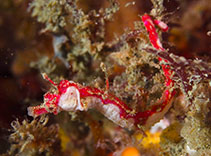
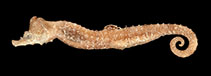
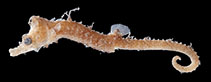
This species is distinguished by the following: with a unique anatomical features of the head, including: a distinct, cup-like crest present anterodorsally on the supraoccipital; with large and conspicuous medioventral conical spines on the cleithral symphysis and the first trunk ring between the pectoral-fin bases; with a prominent supraoccipital; continuous cleithrum; prominent supracleithrum; absence of anterior nuchal plate; posterior nuchal plate with bony dorsomedial crest; presence of a large gap between the supraoccipital and posterior nuchal plate; 1-3 dorsal spines at midline of snout, posteriormost of these spines large; a large double and rugose lateral head spine below the cup-like supraoccipital crest; 3 small blunt lateral head spines on operculum; rim of orbit elevated dorsolaterally and strongly ventrally; 2 spines on cleithral ring; large rugose spine anterior to ventral third of pectoral-fin base; moderate-sized spine at ventral extent of head; a small spine posterolateral to the pelvic-fin base; 4 subdorsal spines, forming a square, the dorsal two enlarged (Ref. 125308).
Cross section: compressed.
This species is observed in mixed habitat on a vertical rock wall covered in encrusting coralline algae, bryozoans, sponges, solitary corals, and turf algae, which faced a rocky outcrop exposed to the open ocean. The rock wall was subject to moderate ocean swell as was evident from the accumulated debris of detached and decomposed algae on the sandy to rubble bottom of the channel at 17-18 m deep. The holotype was collected below the Ecklonia radiata kelp line and it was observed moving about in close proximity to another individual of the same species, which appeared to represent a male-female pair. (Ref. 125308).
Lebenszyklus und Paarungsverhalten
Geschlechtsreife | Fortpflanzung | Ablaichen | Eier | Fruchtbarkeit | Larven
Short, G.A. and T. Trnski, 2021. A new genus and species of pygmy pipehorse from Taitokerau Northland, Aotearoa New Zealand, with a redescription of Acentronura Kaup, 1853 and Idiotropiscis Whitley, 1947 (Teleostei, Syngnathidae). Ichthyol. & Herpetology 109(3):806-835. (Ref. 125308)
IUCN Rote Liste Status (Ref. 130435: Version 2025-2 (Global))
Bedrohung für Menschen
Harmless
Nutzung durch Menschen
Tools
Zusatzinformationen
Download XML
Internet Quellen
Schätzungen auf der Grundlage von Modellen
Phylogenetischer Diversitätsindex (Ref.
82804): PD
50 = 0.7500 [Uniqueness, from 0.5 = low to 2.0 = high].
Bayesian length-weight: a=0.00447 (0.00176 - 0.01132), b=3.00 (2.78 - 3.22), in cm total length, based on LWR estimates for this (Sub)family-body shape (Ref.
93245).
Trophische Ebene (Ref.
69278): 3.2 ±0.5 se; based on size and trophs of closest relatives
Widerstandsfähigkeit (Ref.
120179): hoch, Verdopplung der Population dauert weniger als 15 Monate. (Preliminary K or Fecundity.).
Anfälligkeit der Fischerei (Ref.
59153): Low vulnerability (10 of 100).
🛈