Élasmobranches (requins et raies) (sharks and rays) >
Carcharhiniformes (Ground sharks) >
Pentanchidae (Deepwater catsharks)
Etymology: Parmaturus: parma (L.), from parme (Gr.), small shield; oura (Gr.), tail, presumably referring to upper edge of caudal fin “armed with modified” scales (per Garman 1913) (See ETYFish); angelae: In honor of the fourth author’s granddaughter, Angela (See ETYFish).
Eponymy: The etymology says the fish was “… dedicated to the last author’s granddaughter, Ângela.” (Ref. 128868), visit book page.
Environnement : milieu / zone climatique / profondeur / gamme de distribution
Écologie
marin démersal; profondeur 500 - 600 m (Ref. 125615). Deep-water
Southwestern Atlantic: Brazil.
Taille / Poids / Âge
Maturité: Lm ? range ? - ? cm
Max length : 42.5 cm TL (female)
Description synthétique
Clés d'identification | Morphologie | Morphométrie
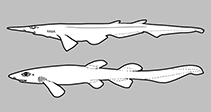
Vertèbres: 121 - 122. Thie species is distinguished from its congeners by the following set of of characters: first dorsal-fin origin slightly anterior to pelvic-fin origin (vs. well anterior in P. campechiensis); dorsal fins subequal (vs. first dorsal fin smaller in P. campechiensis and first dorsal fin slightly larger in P. xaniurus); upper caudal crest of denticles separated from lateral denticles by naked strip (vs. barely separated in P. xaniurus); lower caudal crest of denticles well developed and extending until last third of ventral caudal-fin lobe (vs. extending until the end of ventral caudal-fin lobe in P. campechiensis and reduced or absent in P. xaniurus; labial furrows discontinuous (vs. continuous in P. campechiensis and P. xaniurus); anal-fin base 1.6 times anal-fin height (vs. 3 times in P. campechiensis and 2.2-2.5 in P. xaniurus); pre-first dorsal-fin length 4.3 times interdorsal space (vs. 4.9 times in P. xaniurus); prenarial length 0.8-1.1 times in prepectoral length (vs. 0.3 times in P. campechiensis); mouth width 2.6 times mouth length (vs. 1.9 times in P. campechiensis); monospondylous precaudal centra 38 (vs. 39 in P. campechiensis), and total vertebrae counts 121-122 (vs. 111 in P. campechiensis and 109-121 in P. xaniurus) (Ref. 125615).
Cross section: angular.
Probably a demersal-benthic dwelling shark. The stomach (8.5 cm in length) of the paratype was almost empty, except for one fish eye lens, but an analysis of the intestine (9.0 cm) revealed small pieces of teleostean musculature and a fin spine, a crustacean appendage (pleopod or pereopod), a well-digested 5.0 cm long polychaete body piece, and five dark 22 mm long chaetae, possibly from this same annelid specimen. Reproductive mode oviparous, with just one functional ovary, the right, with four follicles (between 5 and 17 mm diameter), a well-developed nidamental gland, 18 mm (right) and 15 mm (left) in width and fully developed oviducts. Two completely formed slender vase-like dark brown (after fixation) egg cases, one in each oviduct, and both measuring 73 mm in length and 24 mm in width, narrowing at about 1/4 of its length from the anterior border. The surface seems to be smooth in macro view, but with numerous delicate longitudinal ridges and lateral keel along the entire both sides. Both small lateral keel-associated respiratory fissures not reaching to the borders, the anterior measuring 8 mm and the posterior 6 mm in length. Anterior border slightly convex, measuring 1.81 cm in width, pointed in each corner. Posterior margin very small, not measured, with two horn tendrils 3 mm in length in each tip and very small fringed fibrous hair-like filaments between the horns (Ref. 125615).
Cycle de vie et comportement reproducteur
Maturité | Reproduction | Frai | Œufs | Fécondité | Larves
Soares, K.D.D.A., M.R. De Carvalho, P.R. Schwingel and O.B.F. Gadig, 2019. A new species of Parmaturus (Chondrichthyes: Carcharhiniformes: Scyliorhinidae) from Brazil, Southwestern Atlantic. Copeia, 107(2):314-322. (Ref. 125615)
Statut dans la liste rouge de l'IUCN (Ref. 130435: Version 2025-2 (Global))
Menace pour l'homme
Harmless
Utilisations par l'homme
Outils
Articles particuliers
Télécharger en XML
Sources Internet
Estimations basées sur des modèles
Indice de diversité phylogénétique (Réf.
82804): PD
50 = 0.5078 [Uniqueness, from 0.5 = low to 2.0 = high].
Bayesian length-weight: a=0.00347 (0.00172 - 0.00698), b=3.08 (2.90 - 3.26), in cm total length, based on LWR estimates for this (Sub)family-body shape (Ref.
93245).
Niveau trophique (Réf.
69278): 4.0 ±0.5 se; based on size and trophs of closest relatives
Résilience (Réf.
120179): Haut, temps minimum de doublement de population inférieur à 15 mois (Preliminary K or Fecundity.).
Vulnérabilité de la pêche (Ref.
59153): Low to moderate vulnerability (33 of 100).
🛈