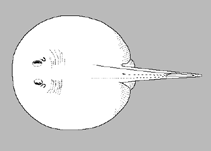
การจำแนกประเภท / ชื่อ
ชื่อสามัญ | ชื่อพ้อง | Catalog of Fishes(สกุล, ชนิด) | ITIS | CoL | WoRMS | Cloffa
sub class Elasmobranchii (ฉลามและกระเบน) (sharks and rays) >
Myliobatiformes (Stingrays) >
Potamotrygonidae (River stingrays) > Potamotrygoninae
Etymology: Paratrygon: Greek, para in the side of + Greek, trygon = a sting ray (Ref. 45335); orinocensis: Named for its type locality, Orinoco basin; a toponym.
สิ่งแวดล้อม : สิ่งแวดล้อม / เขตภูมิอากาศ / ระดับความลึก / ระยะการกระจายสินค้า
นิเวศวิทยา
; น้ำจืด สัตว์น้ำหน้าดิน. Tropical
South Anerica: Colombia.
ขนาด / น้ำหนัก / อายุ
วัยเจริญพันธุ์: Lm ? range ? - ? cm
Max length : 58.4 cm TL เพศผู้/กระเทย; (Ref. 125391)
คำอธิบายสั้นๆ
เครื่องมือที่ใช้ในการแยกชนิดสัตว์,สิ่งมีชีวิตออกจากกัน | สัณฐานวิทยา | ความยาวต่างๆ
This species is distinguished from its congeners by the following set of characters: lateral rows of thorns on tail absent (vs. present); dermal denticles on the central region of the disc have wide and high crowns, presenting a central coronal plate very similar morphologically to its lateral coronal ridges, which in adults can be more than 12 (vs. small dermal denticles on the central disc, with high and narrow crowns presenting higher and pointed central coronal plates surrounded by minor, pointed or rounded lateral coronal ridges, which in turn vary between three and six); teeth 22-35/20-29 (vs.16-26/14-20 in aiereba and 31/19-22 parvaspina); central teeth with more developed and high cusps than aiereba, parvaspina; spiracles are small and triangular, with mean length 5.6% DW [4.5-7.9% DW] (vs. quadrangular and larger spiracles in aiereba with mean length 6% DW [4.4-11.6% DW], and very small and quadrangular spiracles in parvaspina with mean length 5.2% DW [4.9-5.8% DW]; with a short and straight spiracular process with developed and numerous dermal denticles (vs. larger and knob shaped spiracular process that almost covers the spiracle aperture and with some small dermal denticles in aiereba, and an extremely short and reduced spiracular process in parvaspina that is more perceptible in adult specimens, with few dermal denticles); with a minute rostral projection (vs. with a relatively large rostral projection in aiereba, and with a large and circular rostral projection in parvaspina) (Ref. 125391).
Cross section: flattened.
วงจรชีวิตและพฤติกรรมการผสมพันธุ์
วัยเจริญพันธุ์ | การสืบพันธุ์ | การวางไข่ | เซลสืบพันธ์ของเพศเมีย(ไข่) | ความดกของไข่ | ตัวอ่อน
Loboda, T.S., C.A. Lasso, R. de Souza Rosa and M.R. de Carvalho, 2021. Two new species of freshwater stingrays of the genus Paratrygon (Chondrichthyes: Potamotrygonidae) from the Orinoco basin, with comments on the taxonomy of Paratrygon aiereba. Neotrop. Ichthyol. 19(2). (Ref. 125391)
สถานะบัญชีแดงของ IUCN (Ref. 130435: Version 2025-2 (Global))
ภัยคุกคามต่อมนุษย์
Harmless
การใช้ของมนุษย์
เครื่องมือ
รายงานพิเศษ
ดาวน์โหลด XML
แหล่งที่มาจากอินเตอร์เน็ต
การประมาณค่าตามแบบจำลอง
ดัชนีความหลากหลายทางวิวัฒนาการ (อ้างอิง
82804): PD
50 = 0.6250 [Uniqueness, from 0.5 = low to 2.0 = high].
Bayesian length-weight: a=0.01000 (0.00244 - 0.04107), b=3.04 (2.81 - 3.27), in cm total length, based on all LWR estimates for this body shape (Ref.
93245).
ระดับชั้นอาหาร (อ้างอิง
69278): 3.2 ±0.4 se; based on size and trophs of closest relatives
ความเสี่ยงต่อการตกปลา (Ref.
59153): Moderate vulnerability (43 of 100).
🛈