التصنيف / الأسماء
الأسماء الشائعة | مرادفات | Catalog of Fishes(جنس, الانواع) | ITIS | CoL | WoRMS | Cloffa
>
Cyprinodontiformes (Rivulines, killifishes and live bearers) >
Nothobranchiidae (African rivulines)
Etymology: Aphyosemion: Greek, aphye, -es, sardine, anchovy + Greek, semeion = mark, signal (Ref. 45335).
البيئة: الوسط / المنطقة المناخية / نطاق العمق / نطاق التوزيع
البيئة
; المياه العذبة محيطي. Tropical
Africa: Leyou River, in the southern Massif du Chaillu, Louessé River basin, in Republic of the Congo (Ref. 125647).
الحجم / وزن / العمر
النضج: Lm ? range ? - ? cm
Max length : 2.8 cm SL ذكر/ مختلط الجنس; (Ref. 125647)
وصف مختصر
مفاتيح التعريف | الوصف الخارجي | قياسات المظهر الخارجي
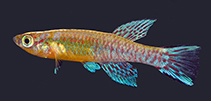
الأشواك الظهرية (المجموع) : 0; الأشعة الظهرية الناعمة (المجموع) : 11 - 12; شوكة شرجية: 0; أشعه شرجية لينه: 14 - 15. Diagnosis: Aphyosemion cyanoflavum is a member of the Aphyosemion ogoense group based on DNA analysis (Ref. 125647). It can be distinguished from all other Aphyosemion species by its cephalic lateral line system, having unique large, dark coloured anterior supra-orbital neuromasts in very wide supra-orbital grooves, 18.3-19.4% of inter-orbital width vs. 7.3-16.9% in other species; very large pre- and postorbital canals with large pores and frontal neuromasts housed in one pit with one anterior lobe; by its wide upper jaw, due to enlarged lacrimal bones, wider than inter-orbital distance versus narrower in all other species, making the dorsal and lateral view of the head much more remniscent of an Epiplatys than an Aphyosemion (Ref. 125647). Males are distinguished from all other Aphyosemion species by their unique lateral colour pattern: anterior part of body on side yellow and posterior side of body purple-grey; the transition between yellow and purple-grey is very sharp and situated just behind the pelvic fin (Ref. 125647). Males are distinguished from all other members of the A. ogoense group, except for A. caudofasciatum, A. pyrophore, and A. thysi, by the presence of narrow dark red bars in the posterior part of the flanks and on the caudal peduncle; males are distinguished from the latter three species by the above mentioned wide supra-orbital grooves and the unique colour pattern of anterior yellow and posterior purple grey on the flanks (Ref. 125647).
Cross section: oval.
Known from the type locality where it is found syntopic with Aphyosemion coeleste and A. mandoroense, where they occur in more or less similar microhabitats (Ref. 125647).
دورة الحياة وسلوك التزاوج
النضج | التكاثر | وضع البيض | بيض | الخصوبة | اليرقات
van der Zee, J.R., G. Walsh, V.N. Boukaka Mikembi, M.N. Jonker, M.P. Alexandre and R. Sonnenberg, 2018. Three new endemic Aphyosemion species (Cyprinodontiformes: Nothobranchiidae) from the Massif du Chaillu in the upper Louessé River system, Republic of the Congo. Zootaxa 4369(1):63-92. (Ref. 125647)
حالة القائمة الحمراء للاتحاد الدولي لحفظ الطبيعة والموارد الطبيعية (Ref. 130435: Version 2025-2 (Global))
استخدامات بشرية
مصائد: غير ذات اهمية
أدوات
تقارير خاصة
تنزيل XML
مصادر علي الأنترنت
تقديرات تستند إلى النماذج
مؤشر التنوع الشُعبي الوراثي (مرجع
82804): PD
50 = 0.5000 [Uniqueness, from 0.5 = low to 2.0 = high].
Bayesian length-weight: a=0.00603 (0.00250 - 0.01453), b=3.13 (2.93 - 3.33), in cm total length, based on LWR estimates for this (Sub)family-body shape (Ref.
93245).
مستوى غذائي (مرجع
69278): 3.1 ±0.4 se; based on size and trophs of closest relatives
ضعف الصيد (Ref.
59153): Low vulnerability (10 of 100).
🛈