klasifikasi / Nama
Nama-nama umum | Sinonim (persamaan) | Catalog of Fishes(Marga, Jenis) | ITIS | CoL | WoRMS | Cloffa
>
Cyprinodontiformes (Rivulines, killifishes and live bearers) >
Nothobranchiidae (African rivulines)
Etymology: Aphyosemion: Greek, aphye, -es, sardine, anchovy + Greek, semeion = mark, signal (Ref. 45335); mandoroense: The species is named after the Mandoro River, a tributary of the Louessé River in the southern Massif du Chaillu in the Republic of the Congo (Ref. 125647).
Lingkungan: lingkungan / zona iklim / kisaran kedalaman / jangkauan distribusi
Ekologi
; air tawar pelagis, permukaan. Subtropical
Africa: tributaries of the upper Mandoro River, Louessé basin, in south-western Congo (Ref. 125647).
Ukuran / Berat / umur
Kematangan: Lm ? range ? - ? cm
Max length : 3.7 cm SL jantan/; (Ref. 125647); 3.8 cm SL (female)
deskripsi pendek
Kunci identifiaksi (pengenalan) | Morfologi | Morfometrik
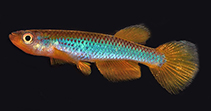
Duri punggung (Keseluruhan (total)) : 0; duri punggung lunak (Keseluruhan (total)) : 11 - 12; Duri dubur: 0; Sirip dubur lunak: 16 - 17. Diagnosis: Males of Aphyosemion mandoroense are distinguished from all other Aphyosemion species by the lack of red pigmentation on its fins, except for the posterior margin of the dorsal fin in some specimens; DNA data and male colour pattern place it into the A. coeleste group (Ref. 125647). Aphyosemion mandorense can be distinguished by its diagnostic male colouration pattern from all other species of the A. coeleste group by the nearly complete absence of red in unpaired fins, versus red margins or sub-marginal stripes in all other species except A. ocellatum, which shows faint red areas in the unpaired fin centre of some individuals; Aphyosemion mandoroense is distinguished from all other species except A. ocellatum and A. passaroi by its dark grey to black margins of unpaired fins; it is distinguished from A. passaroi by the nearly complete absence of red in fins, blue side and opercle vs. basal broad red stripe in anal fin and orange to brownish or pinkish side and opercule (Ref. 125647). Aphyosemion mandoroense is distinguished from the A. ocellatum populations with blue sides by the three or four rows of red dots on anterior side, the light blue opercle vs. a dark red blotch posterior to operculum, and yellow or orange operculum, and from those with a more brownish to orange body colour by the blue side colour, absence of dark red blotch posterior to operculum and blue operculum; Aphyosemion ocellatum in addition has darker and broader fin margins on pelvic, anal, dorsal, and upper and lower caudal fin (Ref. 125647). The superficially most similar A. citrineipinnis and A. ocellatum also have a reduced red pigmentation on fins, but usually at least traces of a red stripe at the base of the anal fin is present; base of anal fin in A. citrineipinnis blue, central to distal part yellow vs. completely yellow in A. mandoroense; unpaired fin margins in A. mandoroense dark grey to black vs. no or very narrow dark fin margin in A. citrineipinnis; many A. citrineipinnis populations usually show a prominent 'wound mark', a group of dark red scales just behind the operculum, that is always absent in A. mandoroense, which shows three or four rows of red dots on the anterior side above the pelvic fin; the operculum is light blue in A. mandoroense vs. yellow to orange in A. citrineipinnis; in A. mandoroense, the yellow colour of the caudal fin is extended in the dorsal and ventral edge of the caudal peduncle, vs. no yellow on caudal peduncle in A. citrineipinnis; in A. mandoroense, the dorsal fin inserts more posteriorly than in A. citrineipinnis (Ref. 125647).
Cross section: oval.
Siklus hidup dan perilaku kawin
Kematangan | Reproduksi, perkembang biakan | Pemijahan | telur-telur | Fekunditas | Larva
van der Zee, J.R., G. Walsh, V.N. Boukaka Mikembi, M.N. Jonker, M.P. Alexandre and R. Sonnenberg, 2018. Three new endemic Aphyosemion species (Cyprinodontiformes: Nothobranchiidae) from the Massif du Chaillu in the upper Louessé River system, Republic of the Congo. Zootaxa 4369(1):63-92. (Ref. 125647)
Status IUCN Red List (Ref. 130435: Version 2025-2 (Global))
ancaman kepada manusia
Harmless
penggunaan manusia
Alat, peralatan
laporan khas
muat turun XML
Sumber internet
Estimasi berdasarkan model
Indeks keanekaragaman filogenetik (Acuan
82804): PD
50 = 0.5000 [Uniqueness, from 0.5 = low to 2.0 = high].
Bayesian length-weight: a=0.00603 (0.00250 - 0.01453), b=3.13 (2.93 - 3.33), in cm total length, based on LWR estimates for this (Sub)family-body shape (Ref.
93245).
Tingkat Trofik (Acuan
69278): 3.2 ±0.4 se; based on size and trophs of closest relatives
Kerentanan Penangkapan Ikan (Ref.
59153): Low vulnerability (10 of 100).
🛈