Classification / Noms
Noms communs | Synonymes | Catalog of Fishes(Genre, Espèce) | ITIS | CoL | WoRMS | Cloffa
>
Cyprinodontiformes (Rivulines, killifishes and live bearers) >
Nothobranchiidae (African rivulines)
Etymology: Aphyosemion: Greek, aphye, -es, sardine, anchovy + Greek, semeion = mark, signal (Ref. 45335); cryptum: The name cryptum, an adjective from the Greek 'krypton', meaning 'hidden', refers to the fact that the species was first thought to represent just a colour variation of Aphyosemion coeleste and not a species of its own (Ref. 125647).
Environnement : milieu / zone climatique / profondeur / gamme de distribution
Écologie
; eau douce pélagique. Subtropical
Africa: small tributaries of the upper Louessé and Mandoro rivers in the southern Massif du Chaillu within the Republic of the Congo (Ref. 125647).
Taille / Poids / Âge
Maturité: Lm ? range ? - ? cm
Max length : 4.0 cm SL mâle / non sexé; (Ref. 125647); 3.9 cm SL (female)
Description synthétique
Clés d'identification | Morphologie | Morphométrie
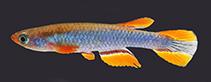
Épines dorsales (Total) : 0; Rayons mous dorsaux (Total) : 9 - 12; Épines anales: 0; Rayons mous anaux: 14 - 16. Diagnosis: Males of Aphyosemion cryptum are distinguished from all other Aphyosemion, except for A. coeleste, by its unique combination of colouration characters in males: a light blue body with a few red markings on flanks and caudal peduncle; yellow to orange on distal part of unpaired fins; base of dorsal and anal fins blue, distally followed by a red band, two parallel or converging red lines along the blue centre of caudal fin; at least in anal and ventral part of caudal fin between red band and yellow to orange distal parts a narrow white line; by mitochondrial DNA results and male colour pattern it clearly belongs to the A. coeleste group (Ref. 125647). It differs from A. coeleste by the lack of a green or yellow iridescent blotch posterior to the operculum; in A. coeleste three to four less regular rows of red spots on anterior part of side within the green or yellow blotch vs. rows of red spots absent or reduced to a few irregular spots in A. cryptum (Ref. 125647).
Cross section: oval.
Cycle de vie et comportement reproducteur
Maturité | Reproduction | Frai | Œufs | Fécondité | Larves
van der Zee, J.R., G. Walsh, V.N. Boukaka Mikembi, M.N. Jonker, M.P. Alexandre and R. Sonnenberg, 2018. Three new endemic Aphyosemion species (Cyprinodontiformes: Nothobranchiidae) from the Massif du Chaillu in the upper Louessé River system, Republic of the Congo. Zootaxa 4369(1):63-92. (Ref. 125647)
Statut dans la liste rouge de l'IUCN (Ref. 130435: Version 2025-2 (Global))
Menace pour l'homme
Harmless
Utilisations par l'homme
Pêcheries: pêcheries vivrières
Outils
Articles particuliers
Télécharger en XML
Sources Internet
Estimations basées sur des modèles
Indice de diversité phylogénétique (Réf.
82804): PD
50 = 0.5000 [Uniqueness, from 0.5 = low to 2.0 = high].
Bayesian length-weight: a=0.00603 (0.00250 - 0.01453), b=3.13 (2.93 - 3.33), in cm total length, based on LWR estimates for this (Sub)family-body shape (Ref.
93245).
Niveau trophique (Réf.
69278): 3.2 ±0.5 se; based on size and trophs of closest relatives
Vulnérabilité de la pêche (Ref.
59153): Low vulnerability (10 of 100).
🛈