Elasmobranchii (haaien en roggen) (sharks and rays) >
Squatiniformes (Angel sharks) >
Squatinidae (Angel sharks)
Etymology: Squatina: Latin for skate, which angel sharks superficially resemble, presumably tautonymous with Squalus squatina Linnaeus 1758 (no species mentioned) (See ETYFish); mapama: Named for the Ministerio de Agricultura y Pesca, Alimentación y Medio Ambiente, MAPAMA, which is the Spanish governmental organization that operates the R/V Miguel Oliver that facilitated the capture of this angelshark, and other new species of deepwater fishes on both sides of the Central American isthmus.
Taxonomic Remarks
Previously confused with Squatina david Acero P., Tavera, Anguila & Hernández, 2016, itself confused with Squatina dumeril Lesueur, 1818
Milieu: milieu / Klimaatzone / Diepte / verspreidingsgebied
Ecologie
marien demersaal; diepte 1190 - 1259 m (Ref. 125651). Tropical
Westen Central Atlantic: Panama.
Grootte / Gewicht / Leeftijd
Maturiteit: Lm ? range ? - ? cm
Max length : 40.0 cm TL mannelijk / geslacht onbekend; (Ref. 125651)
Korte beschrijving
Determinatiesleutels | Morfologie | Morfometrie
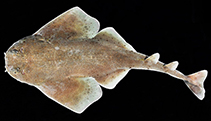
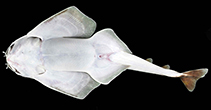
Wervels: 137. This species is distinguished by the following set of characters: with a single row of slightly enlarged dermal denticles along the dorsal midline extending between level just anterior of posterior insertion of pelvic fins and anterior base of first dorsal fin and continuing rearwards along dorsal ridge of tail between first and second dorsal fins; a few large denticles on top of the head; nasal flap squared with a fine fringe on ventral edge; two short lateral barbels bluntly rounded also with a fine fringed margin; males with a dorsal color pattern of small, scattered, dark spots distributed over a uniform light-brown background; pectoral-fin span 52.0-58.1% TL; pelvic-fin span 30.7-31.0 % TL; pre-pectoral-fin length 19.4-19.8% TL; trunk width 18.1-19.5% TL; head length 16.5-17.5% TL; spiracle length 2.2-2.3% TL; eye-to-spiracle length 2.2-5.0 % TL; mouth width 10.5-12.1% TL; nostril width 1.6-2.3% TL; snout-to-pectoral distance 19.4-19.8%; spiracle width 2.2-2.3% TL; pectoral-fin inner margins 17.5-18.3% (Ref. 125651).
Cross section: flattened.
Levenscyclus en paargedrag
Maturiteit | Voortplanting | Paaien | Eieren | Fecunditeit | Larven
Long, D.J., D.A. Ebert, J. Tavera, A. Acero P. and D.R. Robertson, 2021. Squatina mapama n. sp., a new cryptic species of angel shark (Elasmobranchii: Squatinidae) from the southwestern Caribbean Sea. J. Ocean Sci. Found. 38:113-130. (Ref. 125651)
Status op de Rode Lijst van het IUCN (Ref. 130435: Version 2025-2 (Global))
Gevaar voor de mens
Harmless
Gebruik door de mens
Visserij: van geen belang
Tools
Speciale rapporten
Download XML
Internetbronnen
Schattingen op basis van modellen
Fylogenetische diversiteitsindex (Ref.
82804): PD
50 = 0.5000 [Uniqueness, from 0.5 = low to 2.0 = high].
Bayesian length-weight: a=0.00389 (0.00180 - 0.00842), b=3.12 (2.94 - 3.30), in cm total length, based on all LWR estimates for this body shape (Ref.
93245).
Trofisch niveau (Ref.
69278): 3.8 ±0.5 se; based on size and trophs of closest relatives
Weerstandsvermogen (Ref.
120179): Gemiddeld, minimale populatieverdubbelingstijd 1,4-4,4 jaar (Preliminary K or Fecundity.).
Kwetsbaarheid van de visserij (Ref.
59153): Low to moderate vulnerability (30 of 100).
🛈