Classificazione / Nomi
Nomi Comuni | Sinonimi | Catalog of Fishes(Genere, Specie) | ITIS | CoL | WoRMS | Cloffa
Elasmobranchi (squali e razze) (sharks and rays) >
Carcharhiniformes (Ground sharks) >
Scyliorhinidae (Cat sharks) > Scyliorhininae
Etymology: Scyliorhinus: skylion, Greek for dogfish or small shark; rhinus, from rhine (Gr.), rasp, alluding to a shark’s jagged, rasp-like skin (See ETYFish); hachijoensis: Named for the species’ main collection area, Hachijojima Island.
Ambiente: milieu / zona climatica / distribuzione batimetrica / gamma di distribuzione
Ecologia
marino demersale(Ref. 125694). Temperate
Northwest Pacific: Japan.
Dimensione / Peso / Età
Maturità: Lm ? range ? - ? cm
Max length : 41.6 cm TL maschio/sesso non determinato; (Ref. 125694); 38.6 cm TL (female)
Breve descrizione
Chiavi di identificazione | Morfologia | Morfometria
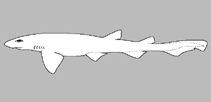
This species is distinguished from its congeners by the following characters: anterior nasal flaps not reaching the upper lip (vs. flaps reaching upper lip, and sometimes covering it, in canicula, cervigoni, comoroensis, duhamelii, garmani, stellaris); absence of nasoral grooves and posterior nasal flaps situated posterior to excurrent apertures (vs. present and posterior nasal flaps laterally situated in canicula, duhamelii); mouth length less than half of mouth width (vs. mouth length more than or equal half of mouth width except in torazame, ugoi); anal fin height more than caudal peduncle height (vs. less in boa, duhamelii, torazame, torrei), and greater than or equal to half of mouth width (vs. less than half of mouth width in boa, capensis, duhamelii, haeckelii, hesperius, meadi, torazame, torrei, ugoi); saddles darker than the background color (vs. inconspicuous or absent in boa, cabofriensis, cervigoni, duhamelii, garmani, torrei, and dark lines in retifer). Colouration: body grayish brown to dark brown with well-defined light spots and small dark spots (vs. no spots in retifer, yellow to golden spots in capensis, no light spots in cervigoni, garmani, meadi, retifer, and no dark spots in capensis, comoroensis, hesperius, meadi, torazame, torrei); light spots spiracle-sized or larger (vs. predominantly smaller than spiracles in boa, cabofriensis, canicula, duhamelii, stellaris, ugoi); dark spots smaller than spiracles (vs. predominantly larger than spiracles in cervigoni, duhamelii, garmani, haeckelii, stellaris); number of monospondylous vertebrae 34-36 (vs. counts higher except in duhamelii, torazame, torrei); clasper with hooks (vs. none inn other pecies except torazame); accessory terminal cartilage present (vs. absent in cabofriensis, cervigoni, comoroensis, duhamelii, haeckelii, stellaris, torrei, ugoi); egg case surface with irregularities (vs. smooth in all other species) (Ref. 125694).
Cross section: angular.
The size of males ranged from 29.4-41.6 cm TL (n = 6) and females from 30.1-38.6 cm TL (n = 22); size at first maturity is not precisely defined, but males had well-developed claspers at 34.6 cm TL and females had egg cases at 34.2 cm TL. Reproduction is by single oviparity, one egg case for each oviduct. The egg cases are amber in color, with tendrils and surface irregularities that resemble wrinkles. Maximum case length without tendrils (ML) was 44.6–56.25 mm, and maximum case width was 19.45–22.5 mm (33.4–42.1 %ML) (n = 7). Stomachs contents have small crustaceans, small bony fishes, and polychaets (Ref. 125694),
Ciclo vitale e comportamento di accoppiamento
Maturità | Riproduzione | Deposizione | Uova | Fecondità | Larve
Ito, N., M. Fujii, K. Nohara and S. Tanaka, 2022. Scyliorhinus hachijoensis, a new species of catshark from the Izu Islands, Japan (Carcharhiniformes: Scyliorhinidae). Zootaxa 5092(3):331-349. (Ref. 125694)
Stato della Lista Rossa IUCN (Ref. 130435: Version 2025-2 (Global))
Minaccia per l'uomo
Harmless
Usi umani
Strumenti
Rapporti speciali
Scarica XML
Fonti Internet
Stime basate su modelli
Indice di diversità filogenetica (Fonte Biblio.
82804): PD
50 = 0.5000 [Uniqueness, from 0.5 = low to 2.0 = high].
Bayesian length-weight: a=0.00269 (0.00140 - 0.00518), b=3.21 (3.04 - 3.38), in cm total length, based on LWR estimates for this (Sub)family-body shape (Ref.
93245).
Livello trofico (Fonte Biblio.
69278): 3.8 ±0.5 se; based on size and trophs of closest relatives
Resilienza (Fonte Biblio.
120179): Medio, tempo minimo di raddoppiamento della popolazione 1.4 - 4.4 anni (Preliminary K or Fecundity.).
Vulnerabilità della pesca (Ref.
59153): Low to moderate vulnerability (32 of 100).
🛈