Classificação / Nomes
Nomes comuns | Sinónimos | Catalog of Fishes(Género, Espécies) | ITIS | CoL | WoRMS | Cloffa
Holocephali (quimeras) (chimaeras) >
Chimaeriformes (Chimaeras) >
Rhinochimaeridae (Longnose chimaeras)
Etymology: Harriotta: [an]a- (L.), belonging to: per Goode & Bean (1896), in honor of Thomas Harriott (ca. 1560‒1621), English astronomer, mathematician, ethnographer and translator, who published the first English work on American natural history (1588) (See ETYFish).
Eponymy: Thomas Harriott (ca: 1560–1621) was an English astronomer, mathematician, ethnographer and translator, who published first English work on American natural history (1588). [...] (Ref. 128868), visit book page.
Ambiente: milieu / zona climática / intervalo de profundidade / gama de distribuição
Ecologia
marinhas batidemersal; intervalo de profundidade 906 - 1654 m (Ref. 123553). Temperate
Northwestern Pacific: Japan.
Tamanho / Peso / Idade
Maturidade: Lm ? range ? - ? cm
Max length : 67.0 cm TL macho/indeterminado; (Ref. 123553); 95.1 cm TL (female)
Descrição breve
Chaves de identificação | Morfologia | Morfometria
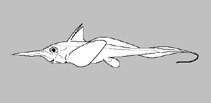
This species is distinguished by the following characters: eye with its length 7-9% BDL; interorbital space 6-9% BDL; snout tip armed with small knob-like projections, only prominent in male; length of dorsal spine anterior margin 19-24% BDL; pectoral and pelvic fins bluntly
pointed; interdorsal space broad 24.8-26.8% BDL; length of caudal dorsal margin (CDM) shorter than caudal ventral margin, CDM 49-62% BDL; length of caudal upper ray (CUR) shorter than that of lower ray, CUR 4-5% BDL; infraorbital canal strongly curved anterior to eye, gently curved; claspers with its outer length 16% BDL and its base width 1% BDL; tip of the clasper a small bulb, with several simple spines sparsely distributed; the slit running longitudinally from dorsolateral base of rod to the ventromesial surface of the knob, running along the dorsal side of the clasper is not prominent (Ref. 123553).
Cross section: angular.
Ciclo de vida e comportamento de acasalamento
Maturidade | Reprodução | Desova | Ovos | Fecundidade | Larvas
Nakayama, N., M. Matsunuma and H. Endo, 2019. A preliminary review and in situ observations of the spookfish genus Harriotta (Holocephali: Rhinochimaeridae). Ichthyol. Res. 67(1):82-91. (Ref. 123553)
Categoria na Lista Vermelha da IUCN (Ref. 130435: Version 2025-2 (Global))
Ameaça para o homem
Harmless
Utilização humana
Ferramentas
Relatórios especiais
Descarregue XML
Fontes da internet
Estimativas baseadas em modelos
Índice de diversidade filogenética (Ref.
82804): PD
50 = 0.6270 [Uniqueness, from 0.5 = low to 2.0 = high].
Bayesian length-weight: a=0.00195 (0.00083 - 0.00455), b=3.14 (2.94 - 3.34), in cm total length, based on LWR estimates for this (Sub)family-body shape (Ref.
93245).
Nível Trófico (Ref.
69278): 3.8 ±0.5 se; based on size and trophs of closest relatives
Vulnerabilidade da pesca (Ref.
59153): High vulnerability (58 of 100).
🛈