>
Perciformes/Serranoidei (Groupers) >
Anthiadidae (Fairy basslets or Streamer basses)
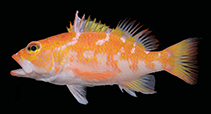
Etymology: Plectranthias: Bleeker (1873) disagrees with the generic placement of Plectropoma anthioides by Günther. He, therefore, erected Plectranthias to accommodate Pl. anthioides. The name is presumably the combination of the first part of Plectropoma (plectrum), and anthias. Plectrum = Plektron = πλῆκτρον (Greek, plektron = anyhting to strike with, spur + Greek, anthias = a fish, Ref. 45335); purpuralepis: The specific name purpuralepis is a combination of the Latin purpura and lepis, meaning purple scales, in reference to the distinct purple color only present after preservation. The name is treated as a noun in apposition.
Milieu: milieu / Klimaatzone / Diepte / verspreidingsgebied
Ecologie
marien rifbewoner; diepte 200 - ? m (Ref. 124021). Deep-water
Northwest Pacific: Northern Taiwan,
Grootte / Gewicht / Leeftijd
Maturiteit: Lm ? range ? - ? cm
Max length : 15.1 cm SL mannelijk / geslacht onbekend; (Ref. 124021)
Korte beschrijving
Determinatiesleutels | Morfologie | Morfometrie
Dorsale stekels (totaal) : 10; Dorsale zachte stralen (totaal) : 16 - 17; Anale stekels: 3; Anale zachte stralen: 7; Wervels: 26. This species is distinguised by the following characters: the pectoral and pelvic fins are mostly covered by small scales and scales on the whitish pink blotches turn purple when preserved; D X,16-17 with the 3rd dorsal-fin spine longest; pectoral-fin rays usually 14, all branched except for uppermost ray simple; principal caudal-fin rays 9 + 8; pored lateral-line scales 32036; cheek with 6 diagonal rows of large scales; circumpeduncular scales 14; ca. 7 rows of large predorsal scales, 2 irregular rows of small scales extending to a line through posterior nostrils; maxilla and chin scaleless; posterior margin of preopercle serrated, the ventral margin with 2 antrorse spines; the greatest body depth 32.6-35.1% SL (Ref. 124021).
Cross section: compressed.
This species apparently occurs on rocky reef bottom or slope in the mesophotic zone. Judging from other specimens (Parapercis spp., Plectranthias kamii, P. sheni, Helicolenus hilgendorfii) collected by anglers together with this species, these were taken at depths of 200 m or below (Ref. 124021).
Levenscyclus en paargedrag
Maturiteit | Voortplanting | Paaien | Eieren | Fecunditeit | Larven
Tang, C,-N., N.-W. Lai and H.-C. Ho, 2020. Plectranthias purpuralepis sp. nov., a new anthiadine perchlet from northern Taiwan (Perciformes: Serranidae). Zootaxa 4780(3):508-522. (Ref. 124021)
Status op de Rode Lijst van het IUCN (Ref. 130435: Version 2025-2 (Global))
Gevaar voor de mens
Harmless
Gebruik door de mens
Visserij: van geen belang
Tools
Speciale rapporten
Download XML
Internetbronnen
Schattingen op basis van modellen
Fylogenetische diversiteitsindex (Ref.
82804): PD
50 = 0.5000 [Uniqueness, from 0.5 = low to 2.0 = high].
Bayesian length-weight: a=0.01413 (0.00621 - 0.03212), b=3.00 (2.81 - 3.19), in cm total length, based on LWR estimates for this (Sub)family-body shape (Ref.
93245).
Trofisch niveau (Ref.
69278): 3.9 ±0.6 se; based on size and trophs of closest relatives
Weerstandsvermogen (Ref.
120179): Hoog, minimale populatieverdubbelingstijd minder dan 15 maanden (Preliminary K or Fecundity.).
Kwetsbaarheid van de visserij (Ref.
59153): Low vulnerability (10 of 100).
🛈