>
Pleuronectiformes (Flatfishes) >
Cynoglossidae (Tonguefishes) > Symphurinae
Etymology: Symphurus: Greek, syn, symphysis = grown together + Greek, oura = tail (Ref. 45335); longirostris: Name from Latin 'long' for long and 'rostris' for snout; referring to the relatively long snout (especially when compared with S. microrhynchus.).
Ambiente: milieu / zona climatica / distribuzione batimetrica / gamma di distribuzione
Ecologia
marino demersale; distribuzione batimetrica 45 - 100 m (Ref. 109580), usually 60 - 90 m (Ref. 109580). Subtropical
Northwestern Pacific: Japan.
Lunghezza alla prima maturità / Dimensione / Peso / Età
Maturità: Lm ?, range 4 - 6.55 cm
Max length : 6.2 cm SL maschio/sesso non determinato; (Ref. 109580); 6.6 cm SL (female)
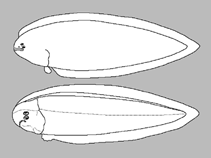
Raggi dorsali molli (totale) : 81 - 88; Raggi anali molli: 68 - 74; Vertebre: 45 - 48. This species is distinguished from all its congeners by the following set of characters: ID pattern1-2-2-2-2; caudal-fin rays 12; vertebrae, abdominal 9 and total 45-48; hypurals 4; D 81-88; A 68-74; ongitudinal scale rows 56-66; transverse scales 21-26; scale rows on the head posterior to the lower orbit 11-14; with a well-developed fleshy ridge on the posterior ocular side lower jaw; upper and lower eyes covered with a membrane; a membranous flap contiguous from anterior nostril to anteroventral margin of lower eye;
upper head lobe wider than the lower head lobe; differs friom S. microrhynchus and S. holothuriae, by having a shorter head and postorbital lengths, longer snout and predorsal lengths, a different snout shape, and with the anterior margin of the upper eye equal to, or slightly in advance of, that of the lower eye. Colouraton: ocular-side uniformly yellow to light brown; blind-side uniformly white without pepper dots; distinct dermal spots on both sides of the bases of the dorsal and anal fins; peritoneum bluish black on its dorsalmost aspect (Ref. 109580).
Cross section: flattened.
Occurs on continental shelf, collected on muddy substrata or a mixture of mud and sand. Caught by bottom trawls (Ref. 109580).
Ciclo vitale e comportamento di accoppiamento
Maturità | Riproduzione | Deposizione | Uova | Fecondità | Larve
Lee, M.-Y., T.A. Munroe and Y. Kai, 2017. Description of a new cryptic species of tonguefish (Pleuronectiformes: Cynoglossidae: Symphurus) from shallow waters off Japan. Ichthyol. Res.64:71-83. (Ref. 109580)
Stato della Lista Rossa IUCN (Ref. 130435: Version 2025-2 (Global))
Minaccia per l'uomo
Harmless
Usi umani
Pesca: bycatch
Strumenti
Rapporti speciali
Scarica XML
Fonti Internet
Stime basate su modelli
Indice di diversità filogenetica (Fonte Biblio.
82804): PD
50 = 0.5000 [Uniqueness, from 0.5 = low to 2.0 = high].
Bayesian length-weight: a=0.00427 (0.00211 - 0.00863), b=3.14 (2.97 - 3.31), in cm total length, based on LWR estimates for this Genus-body shape (Ref.
93245).
Livello trofico (Fonte Biblio.
69278): 3.2 ±0.4 se; based on size and trophs of closest relatives
Resilienza (Fonte Biblio.
120179): Alto, tempo minimo di raddoppiamento della popolazione meno di 15 mesi (Preliminary K or Fecundity.).
Vulnerabilità della pesca (Ref.
59153): Low vulnerability (10 of 100).
🛈