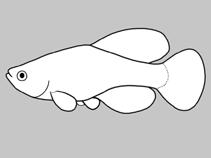
Classification / Noms
Noms communs | Synonymes | Catalog of Fishes(Genre, Espèce) | ITIS | CoL | WoRMS | Cloffa
>
Cyprinodontiformes (Rivulines, killifishes and live bearers) >
Nothobranchiidae (African rivulines)
Etymology: Nothobranchius: Greek, nothos = false + Greek, brangchia = gill (Ref. 45335); cooperi: The specific epithet is given in honour of Barry J. Cooper, renowned collector and breeder of killifish, for his significant contributions to the field study of Nothobranchius and to the killifish hobby in general; a noun in genitive (Ref. 117281).
Eponymy: Barry J Cooper is an American aquarist who collects and breeds killifish. [...] (Ref. 128868), visit book page.
Environnement : milieu / zone climatique / profondeur / gamme de distribution
Écologie
; eau douce pélagique; pH range: 6.2 - 6.4. Tropical; 24°C - 28°C (Ref. 117281)
Africa: upper reaches of Mansa River, tributary of Luapula River, and seasonal Lufimba system, flowing into Lake Bangeulu, in Zambia (Ref. 117281).
Taille / Poids / Âge
Maturité: Lm ? range ? - ? cm
Max length : 2.6 cm SL mâle / non sexé; (Ref. 117281)
Description synthétique
Clés d'identification | Morphologie | Morphométrie
Épines dorsales (Total) : 0; Rayons mous dorsaux (Total) : 14 - 16; Épines anales: 0; Rayons mous anaux: 14 - 16; Vertèbres: 26 - 27. Diagnosis: Nothobranchius cooperi belongs to the Nothobranchius brieni species group (Ref. 117281). With the exception of N. rosenstocki and N. sainthousei, it is distinguished from all other species of that group by having broad orange, vs. red brown, posterior scale margins on the trunk and anal fin, with a uniform orange-red margin, vs. light blue, yellow, red-brown or black margin (Ref. 117281). It is distinguished from N. sainthousei by having an anal fin that is uniform orange-red with an irregular to regular, light blue-green zone close to the base, vs. orange-brown spots and orange-brown margin, and a wider, more prominent light blue marginal band to the caudal fin; head length 32.5-36.2% of standard length vs. 25.1-29.3%; prepectoral length 32.5-36.2% of standard length vs. 25.1-29.4%; and head width 70-77% of its depth vs. 79-86% (Ref. 117281). It is distinguished from N. rosenstocki by having a prepelvic length 48.8-51.9% of standard length vs. 45.1-49.0%; and a head depth 75-77% of head length vs. 78-84% (Ref. 117281). Furthermore, the species is characterised by a caudal peduncle length 1.2-1.3 times its depth, compared to 1.4-1.5 times in N. sainthousei, and 1.6 times in N. rosenstocki (Ref. 117281).
It is a micropredator, feeding on small aquatic crustaceans, worms, insect larvae and other zooplankton (Ref. 117281). The species appears to qualify as vulnerable (B1bii) according to IUCN criteria (Ref. 117281).
Cycle de vie et comportement reproducteur
Maturité | Reproduction | Frai | Œufs | Fécondité | Larves
Nagy, B., B.R. Watters, P.D.W. van der Merve, F.P.D. Cotterill and D.U. Bellstedt, 2017. Nothobranchius cooperi (Teleostei: Cyprinodontiformes): a new species of annual killifish from the Luapula River drainage, northern Zambia. African Journal of Aquatic Science 42(3):201-218. (Ref. 117281)
Statut dans la liste rouge de l'IUCN (Ref. 130435: Version 2025-2 (Global))
Menace pour l'homme
Harmless
Utilisations par l'homme
Outils
Articles particuliers
Télécharger en XML
Sources Internet
Estimations basées sur des modèles
Indice de diversité phylogénétique (Réf.
82804): PD
50 = 0.5000 [Uniqueness, from 0.5 = low to 2.0 = high].
Bayesian length-weight: a=0.01096 (0.00461 - 0.02608), b=2.94 (2.74 - 3.14), in cm total length, based on LWR estimates for this (Sub)family-body shape (Ref.
93245).
Niveau trophique (Réf.
69278): 3.1 ±0.4 se; based on size and trophs of closest relatives
Vulnérabilité de la pêche (Ref.
59153): Low vulnerability (10 of 100).
🛈