>
Cypriniformes (Carps) >
Gobionidae (Gudgeons)
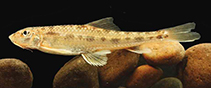
Etymology: lii: Named after Shi-Zhen Li, a native of Qichun County, the species' type locality. He was a well-known medical scientist in the Ming Dynasty, who compiled “Compendium of Materia Medica” (‘本草纲目’ in Chinese). Li had a typical image as an old man with a long white dense beard, just like the eight-barbel gudgeon.
Eponymy: Shi-Zhen Li, or Li Shizhen (1518-1593), was a Chinese naturalist, physician and herbalist most famous for his work: Compendium of Materia Medica. He was born in Qichun County, Hubei, where the gudgeon holotype was caught. (Ref. 128868), visit book page.
Meio ambiente: milieu / Zona climática / intervalo de profundidade / faixa de distribuição
Ecologia
; Água doce bentopelágico. Subtropical
Asia: China.
Tamanho / Peso / Idade
Maturidade: Lm ? range ? - ? cm
Max length : 5.1 cm SL macho/indeterminado; (Ref. 126141)
Descrição suscinta
Chaves de identificação | Morfologia | Morfometria
Vértebras: 35. This species is distinguished from all its congeners (except G. brevirostris, G. homalopteroidea, G. jiangxiensis, G. pappenheimi by the following characters: with a naked region of the abdomen adjacent to the ventral mid-line extending to or beyond the vent (vs. to or away from the pelvic-fin base); vertebra 4 + 31-32 (vs. 4 + 33-37); similar to G. homalopteroidea, G. pappenheimi by having smaller eyes with diameter less than the interorbital width, maxillary barbels longer than the eye diameter and the third pair of longer mental barbels extending to the pectoral-fin insertion (same three characters separates them from G. brevirostris, G. jiangxiensis); differs from G. homalopteroidea in having a smaller (vs. larger) naked region of the abdomen adjacent to the ventral mid-line extending to the anus (vs. to the anal-fin origin) and the eye diameter 20.0-25.8% of HL (vs. 10.8-13.9%); differs from G. pappenheimi in having pectoral fins extending away from (vs. beyond) the pelvic-fin insertion, with the second branched pectoral-fin ray not prolonged (vs. prolonged) and with a longer (vs. shorter) snout than the post-orbital length (Ref. 126141).
Cross section: oval.
Occurs in turbid, slow-running water with mixed substrates including sand and gravel. In Lake Dongting in Hunan, it was collected in lotic habitats or estuaries of effluents. Associated with Misgurnus anguillicaudatus, Opsariichthys bidens, and Parabotia fasciata (Ref. 126141).
Ciclo de vida ou comportamento de acasalamento
Maturidade | Reprodução | Desova | Ovos | Fecundidade | Larvas
Chen, X., M. Wang, L. Cao and E. Zhang, 2022. Gobiobotia lii, a new species of gudgeon (Teleostei, Gobionidae) from the middle Chang-Jiang Basin, central China, with notes on the validity of G. nicholsi Bănărescu & Nalbant, 1966. Zoosyst. Evol. 98(1):93-107. (Ref. 126141)
Status na Lista Vermelha da UICN (Ref. 130435: Version 2025-2 (Global))
Ameaça para os humanos
Harmless
Uso pelos humanos
Ferramentas
Relatórios especiais
Baixar XML
Fontes da internet
Estimativas baseadas em modelos
Índice de diversidade filogenética (Ref.
82804): PD
50 = 0.5000 [Uniqueness, from 0.5 = low to 2.0 = high].
Bayesian length-weight: a=0.00617 (0.00301 - 0.01264), b=3.12 (2.95 - 3.29), in cm total length, based on LWR estimates for this (Sub)family-body shape (Ref.
93245).
Nível Trófico (Ref.
69278): 3.1 ±0.4 se; based on size and trophs of closest relatives
Resiliência (Ref.
120179): Elevada, tempo mínimo de duplicação da população menor que 15 meses (Preliminary K or Fecundity.).
Vulnerabilidade da pesca (Ref.
59153): Low vulnerability (10 of 100).
🛈