>
Stomiiformes (Lightfishes and dragonfishes) >
Sternoptychidae (Marine hatchetfishes) > Sternoptychinae
Etymology: Argyropelecus: Greek, argyros = silvered, silver + Greek, pelekys = axe (Ref. 45335).
Environnement : milieu / zone climatique / profondeur / gamme de distribution
Écologie
marin bathypélagique; profondeur 0 - 2400 m (Ref. 74511), usually 100 - 700 m (Ref. 28981). Deep-water; 60°N - 56°S
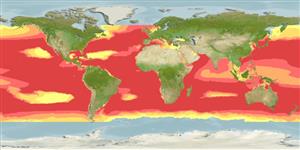
Eastern Atlantic: north of British Isles to South Africa, including western Mediterranean. Western Atlantic: New Jersey, USA to Argentina (Ref. 26340). Northwest Atlantic: Canada (Ref. 5951). Eastern Pacific: throughout the California Current area, seaward of the continental shelf (Ref. 35838). Known from tropical and subtropical waters of all oceans (Ref. 47377). South China Sea (Ref.74511).
Longueur à la première maturité / Taille / Poids / Âge
Maturité: Lm ?, range 3 - ? cm
Max length : 5.1 cm TL mâle / non sexé; (Ref. 96016); poids max. publié: 1.42 g (Ref. 128245); âge max. reporté: 1.00 années (Ref. 5168)
Description synthétique
Clés d'identification | Morphologie | Morphométrie
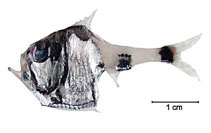
Épines dorsales (Total) : 0; Rayons mous dorsaux (Total) : 8 - 9; Épines anales: 0; Rayons mous anaux: 11 - 12; Vertèbres: 36 - 39. Body bright silvery in color; body and trunk with dusky coloration at night (Ref. 4054). Branchiostegal rays: 10 (Ref. 35838).
Body shape (shape guide): short and / or deep.
Oceanic (Ref. 4739) and mesopelagic, mainly at 250-650 m (Ref. 4054). Depth range from 100-700 m (Ref. 4462) and from 460-1082 m in the eastern Ionian Sea (Ref. 56504). Adults make marked vertical migrations (Ref. 4739). Found singly or in small groups (Ref. 4739). An opportunistic feeder at dusk on calanoid copepods, small fishes, etc (Ref. 4739). Sexual dimorphism with regard to body size (Ref. 5168), the males being slightly smaller than the females (Ref. 8966). Oviparous, with planktonic eggs and larvae (Ref. 35838).
Occurs between 200 and 700 m depth during the day, concentrated between 350 and 550 m, and between 100 and 650 m at night, preferring a depth between 150 and 380 m Ref. 47377). Also Ref. 58302.
Spawns more than once per season with egg batches about 50-500 egg/ovary pair, the number increasing with increased animal size (Ref. 4739).
Gon, O., 1990. Sternoptychidae. p. 123-126. In O. Gon and P.C. Heemstra (eds.) Fishes of the Southern Ocean. J.L.B. Smith Institute of Ichthyology, Grahamstown, South Africa. (Ref. 5168)
Statut dans la liste rouge de l'IUCN (Ref. 130435: Version 2025-2 (Global))
Menace pour l'homme
Harmless
Utilisations par l'homme
Pêcheries: sans intérêt
Outils
Articles particuliers
Télécharger en XML
Sources Internet
Estimations basées sur des modèles
Température préférée (Réf.
123201): 5.5 - 21.3, mean 11.3 °C (based on 2694 cells).
Indice de diversité phylogénétique (Réf.
82804): PD
50 = 0.5078 [Uniqueness, from 0.5 = low to 2.0 = high].
Bayesian length-weight: a=0.01778 (0.01025 - 0.03084), b=3.08 (2.93 - 3.23), in cm total length, based on LWR estimates for this species & Genus-body shape (Ref.
93245).
Niveau trophique (Réf.
69278): 3.1 ±0.14 se; based on food items.
Résilience (Réf.
120179): Haut, temps minimum de doublement de population inférieur à 15 mois (tm=1; tmax=1).
Vulnérabilité de la pêche (Ref.
59153): Low vulnerability (10 of 100).
🛈
Nutriments (Ref.
124155): Calcium = 53 [14, 266] mg/100g; Iron = 0.636 [0.179, 2.130] mg/100g; Protein = 2.42 [0.00, 6.40] %; Omega3 = 0.273 [0.071, 1.024] g/100g; Selenium = 9.22 [2.53, 44.10] μg/100g; VitaminA = 33.7 [3.6, 314.7] μg/100g; Zinc = 0.916 [0.368, 2.357] mg/100g (wet weight);