Classificatie / Namen
Lokale namen | Synoniemen | Catalog of Fishes(Genus, Soort(en)) | ITIS | CoL | WoRMS | Cloffa
>
Cichliformes (Cichlids, convict blennies) >
Cichlidae (Cichlids) > Pseudocrenilabrinae
Etymology: Hemibates: Greek, hemi = the half + Greek, bates, baino = to go, to walk (Ref. 45335); koningsi: The species is named for the first person who recognized the new Hemibates species as a distinct phenotype, Ad Konings, in appreciation of the inspiration to many cichlidophiles that arose from his continued popular and scientific contributions (Ref. 117350).
Eponymy: Dr Adrianus Franciscus Johannes Marinus Maria ‘Ad’ Konings (d: 1956) is a Dutch ichthyologist, cichlid aquarist, photographer, writer and publisher who began collecting cichlids at the age of fourteen. [...] (Ref. 128868), visit book page.
Milieu: milieu / Klimaatzone / Diepte / verspreidingsgebied
Ecologie
; zoet water pelagisch; diepte 40 - 150 m (Ref. 117350), usually 40 - 60 m (Ref. 117350). Tropical
Africa: southern part of Lake Tanganyika from around Mpulungu and the Chituta Bay (Ref. 117350).
Grootte / Gewicht / Leeftijd
Maturiteit: Lm ? range ? - ? cm
Max length : 21.7 cm SL mannelijk / geslacht onbekend; (Ref. 117350)
Korte beschrijving
Determinatiesleutels | Morfologie | Morfometrie
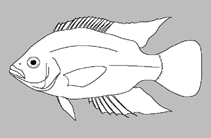
Dorsale stekels (totaal) : 14 - 15; Dorsale zachte stralen (totaal) : 13 - 15; Anale stekels: 3; Anale zachte stralen: 12 - 14; Wervels: 33 - 34. Diagnosis: Adult males of Hemibates koningsi can be distinguished from H. stenosoma, the only congener, by a flank colour pattern of four to seven black vertical bars, two to three flank-scales wide, on the anterior flank region and five horizontal bands, one to two, rarely three flank-scales high, on the posterior flank region vs. black blotches of variable number, size and shape at the anterior part of the flanks and five, rarely four, horizontal bands in H. stenosoma; they can further be distinguished by the fourth horizontal band, counted from dorsal to ventral, starting below pectoral fin base sometimes before and extending to caudal fin base in H. koningsi vs. normally ending well before caudal fin base in H. stenosoma; moreover, both species exhibit a black band on dorsal fin membrane along the dorsal-fin base, which is however wider and more pronounced in H. koningsi males (Ref. 117350). Females as well as males of H. koningsi can be unambiguously separated from H. stenosoma by their longer lower pharyngeal jaw, 37.6-38.2% of head length vs. 27.8-32.5%, with a characteristically curved keel, distinctive bulge ventrally of the keel, which contrasts with the more or less straight keel of H. stenosoma, which is only rounded towards the tip; meristics and measurements of Hemibates koningsi overlap with those of H. stenosoma, but H. koningsi on average has fewer gill rakers on the first gill arch, 33-37 vs. 35-43; it tend to have longer lower jaws, 44.0-47.1% of head length vs. 39.22-45.9%, longer upper lips, 32.6-36.7% of head length vs. 27.6-33.6%, and longer lower lips, 34.5-37.8% of head length vs. 30.1-36.0% (Ref. 117350).
This species appears to be epibenthic (Ref. 117350).
Levenscyclus en paargedrag
Maturiteit | Voortplanting | Paaien | Eieren | Fecunditeit | Larven
Schedel, F.D.B. and U.K. Schliewen, 2017. Hemibates koningsi spec. nov: a new deep-water cichlid (Teleostei: Cichlidae) from Lake Tanganyika. Zootaxa 4312(1):92-112. (Ref. 117350)
Status op de Rode Lijst van het IUCN (Ref. 130435: Version 2025-2 (Global))
Gevaar voor de mens
Harmless
Gebruik door de mens
Tools
Speciale rapporten
Download XML
Internetbronnen
Schattingen op basis van modellen
Fylogenetische diversiteitsindex (Ref.
82804): PD
50 = 0.7500 [Uniqueness, from 0.5 = low to 2.0 = high].
Bayesian length-weight: a=0.01445 (0.00671 - 0.03113), b=2.99 (2.82 - 3.16), in cm total length, based on LWR estimates for this (Sub)family-body shape (Ref.
93245).
Trofisch niveau (Ref.
69278): 3.5 ±0.5 se; based on size and trophs of closest relatives
Weerstandsvermogen (Ref.
120179): Hoog, minimale populatieverdubbelingstijd minder dan 15 maanden (Preliminary K or Fecundity.).
Kwetsbaarheid van de visserij (Ref.
59153): Low vulnerability (17 of 100).
🛈