Classification / Noms
Noms communs | Synonymes | Catalog of Fishes(Genre, Espèce) | ITIS | CoL | WoRMS | Cloffa
>
Ophidiiformes (Cusk eels) >
Ophidiidae (Cusk-eels) > Neobythitinae
Etymology: Tenuicephalus: Name from Latin 'tenuis' for thin, weak and 'cephalus' for 'head', referring to the delicate and weak nature of the head ossification which often results in damaged specimens when recovered from deep-water trawls; multitrabs: Name from Latin 'multi' meaning many or multi, and 'trabs' for club or spar, referring to the many long rakers in this species as compared to T. melampeplus.
Environnement : milieu / zone climatique / profondeur / gamme de distribution
Écologie
marin benthopélagique; profondeur 1000 - 2000 m (Ref. 125143). Deep-water
Indian Ocean (except for its northern part) and the western Pacific.
Taille / Poids / Âge
Maturité: Lm ? range ? - ? cm
Max length : 20.2 cm SL mâle / non sexé; (Ref. 125143)
Description synthétique
Clés d'identification | Morphologie | Morphométrie
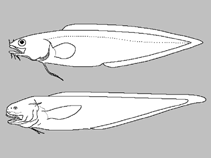
This species is distinguished by the following characters: precaudal vertebrae 14-16, loin vertebrae 3-5 the last precaudal vertebrae without ribs; first gill arch with long gill rakers 18-21; pectoral-fin rays 16-18; HL:HD 1.38-1.63; maximal HD:HD through center of eye 1.35-1.70; weak head spines on ethmoidal, interorbital and 5th infraorbital; opercular spine sharp and extruding; opercular flap is moderately large; vomer narrow, naked or with few teeth or one row of teeth; palatines narrow with 1-3 rows of teeth; basibranchial tooth patch small, narrow with 1-3 rows of teeth; otolith large, 11.5-14.5 % in HL, with single colliculum; OL:OH = 1.22-1.34; OL:TCL = 2.46-2.92 (Ref. 125143).
Cross section: compressed.
The largest number of specimens were caught at great distance from the nearest shelf areas in the central Indian Ocean, nearly 2000 km above the Ninety-East Ridge. It was caught well above the sea bottom indicating that these fishes might obtain a bathypelagic rather than a benthopelagic life style (Ref. 125143).
Cycle de vie et comportement reproducteur
Maturité | Reproduction | Frai | Œufs | Fécondité | Larves
Schwarzhans, W.W. and P.R. Møller, 2021. Revision of the ‘dragon-head’ cusk eels of the genus Porogadus (Teleostei: Ophidiidae), with description of eight new species and one new genus. Zootaxa 5029(1):001-096. (Ref. 125143)
Statut dans la liste rouge de l'IUCN (Ref. 130435: Version 2025-2 (Global))
Menace pour l'homme
Harmless
Utilisations par l'homme
Outils
Articles particuliers
Télécharger en XML
Sources Internet
Estimations basées sur des modèles
Indice de diversité phylogénétique (Réf.
82804): PD
50 = 0.5625 [Uniqueness, from 0.5 = low to 2.0 = high].
Bayesian length-weight: a=0.00380 (0.00165 - 0.00876), b=3.14 (2.93 - 3.35), in cm total length, based on LWR estimates for this (Sub)family-body shape (Ref.
93245).
Niveau trophique (Réf.
69278): 3.5 ±0.6 se; based on size and trophs of closest relatives
Résilience (Réf.
120179): Haut, temps minimum de doublement de population inférieur à 15 mois (Preliminary K or Fecundity.).
Vulnérabilité de la pêche (Ref.
59153): Low vulnerability (15 of 100).
🛈