>
Cichliformes (Cichlids, convict blennies) >
Cichlidae (Cichlids) > Pseudocrenilabrinae
Etymology: Haplochromis: Greek, Haploos = single + Greek, chromis = a fish, perhaps a perch (Ref. 45335); simba: Species name from Swahili 'simba' for 'lion'; referring to yellow body, orange cheeks that resemble manes, and predatory morphology (Ref. 126312).
Môi trường: môi trường / vùng khí hậu / Mức độ sâu / phạm vi phân phối
Sinh thái học
; nước ngọt tầng nổi. Tropical
Africa: Lake Edward (Ref. 126312).
Bộ gần gũi / Khối lượng (Trọng lượng) / Tuổi
Chín muồi sinh dục: Lm ? range ? - ? cm
Max length : 10.9 cm SL con đực/không giới tính; (Ref. 126312)
Mô tả ngắn gọn
Khóa để định loại | Hình thái học | Sinh trắc học
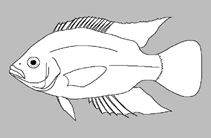
Các tia vây lưng cứng (tổng cộng) : 14 - 16; Các vây lưng mềm (tổng cộng) : 9 - 10; Tia cứng vây hậu môn: 3; Tia mềm vây hậu môn: 8 - 9; Động vật có xương sống: 30 - 31. Diagnosis: Species with a piscivorous morphology; premaxillary pedicel and mental prominences strongly developed; outer oral teeth few and large, 22-31; dominant males yellow with an orange anterior part of flank (Ref. 126312). Amongst piscivorous species from the Lake Edward system, Haplochromis simba differs from H. latifrons, H. mentatus, and H. glaucus by the combination of a narrower interorbital area, interorbital width 45.5-50.4% of head width vs. 50.9-63.3%; and a strongly developed vs. absent or weakly developed mental prominence; it further differs from H. latifrons by a longer anal fin base, 17.3-19.0% of standard length vs. 14.7-17.3%; and absence vs. presence of a well-defined mid-lateral band; further from H. mentatus by a smaller number of outer upper jaw teeth, 22-31 vs. 28-46; and dominant males yellow with an orange anterior part of flank vs. green-yellow with a red anterior part of flank; further from H. glaucus by a narrower lower pharyngeal element, lower pharyngeal width 83.8-87.9% of lower pharyngeal length vs. 93.3-95.1%; and dominant males yellow with an orange anterior part of flank vs. uniformly light-blue (Ref. 126312). It differs from H. rex and H. aquila by the combination of a smaller number of scales between first anal-fin spine and upper lateral line, 9-11 vs. 12-16, rarely 11; and a strongly developed vs. absent or weakly developed mental prominence; it further differs from H. rex by a lower number of longitudinal line scales, 32-33 vs. 34-38; and dominant males uniformly yellow with an orange anterior part of flank vs. cream-coloured with an orange operculum and a light blue snout; further from H. aquila by a smaller eye, eye diameter 26.7-29.5% of head length vs. 30.0-31.5%; and dominant males yellow with an orange anterior part of flank and a yellow head vs. uniformly light grey with a black head (Ref. 126312). It differs from H. kimondo, H. falcatus, H. curvidens, H. pardus, H. quasimodo, and H. squamipinnis by the combination of large vs. small outer oral teeth and a smaller number of outer upper jaw teeth, 22-31 vs. 39-79; it further differs from H. falcatus, H. curvidens, and H. pardus by a deeper lacrimal, lacrimal depth 18.7-20.5% of head length vs. 16.0-18.8%; further from H. kimondo and H. quasimodo by a narrower head, head width 39.5-41.5% of head length vs. 42.0-48.1%; further from H. squamipinnis by absence vs. presence of minute scales on proximal part of dorsal fin (Ref. 126312).
Found in inshore areas over hard substrates (Ref. 126312). Based on its morphology, most probably a piscivorous species (Ref. 126312).
Vòng đời và hành vi giao phối
Chín muồi sinh dục | Sự tái sinh sản | Đẻ trứng | Các trứng | Sự sinh sản | Ấu trùng
Vranken, N., M. Van Steenberge, A. Heylen, E. Decru and J. Snoeks, 2022. From a pair to a dozen: the piscivorous species of Haplochromis (Cichlidae) from the Lake Edward system. Eur. J. Taxon. 815:1-94. (Ref. 126312)
Tình trạng Sách đỏ IUCN (Ref. 130435: Version 2025-2 (Global))
Mối đe dọa đối với con người
Harmless
Sử dụng của con người
Các công cụ
Báo cáo đặc biệt
Tải xuống XML
Các nguồn internet
Ước tính dựa trên mô hình
Chỉ số đa dạng phát sinh loài (Tài liệu tham khảo
82804): PD
50 = 0.5000 [Uniqueness, from 0.5 = low to 2.0 = high].
Bayesian length-weight: a=0.01445 (0.00671 - 0.03113), b=2.99 (2.82 - 3.16), in cm total length, based on LWR estimates for this (Sub)family-body shape (Ref.
93245).
Mức dinh dưỡng (Tài liệu tham khảo
69278): 3.4 ±0.4 se; based on size and trophs of closest relatives
Thích nghi nhanh (Tài liệu tham khảo
120179): Chiêù cao, thời gian nhân đôi của chủng quần tối thiểu là dưới 15 tháng (Preliminary K or Fecundity.).
Sự dễ bị tổn thương của nghề đánh cá (Ref.
59153): Low vulnerability (10 of 100).
🛈