Clasificación / Nombres
Nombres comunes | Sinónimos | Catalog of Fishes(Género, Especie) | ITIS | CoL | WoRMS | Cloffa
Entorno: milieu / zona climática / rango de profundidad / gama de distribución
Ecología
; agua dulce bentopelágico. Tropical
Africa: Ubangi River, Congo River basin, in Central African Republic (Ref. 123814).
Tamaño / Peso / Edad
Madurez: Lm ? range ? - ? cm
Max length : 20.7 cm SL macho / no sexado; (Ref. 123814)
Descripción breve
Claves de identificación | Morfología | Morfometría
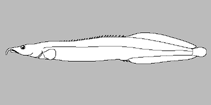
Espinas dorsales (total) : 10; Radios blandos dorsales (total) : 101; Vértebra: 81. Diagnosis: Mastacembelus ubangipaucispinis is most similar to M. paucispinis in having 10 dorsal-fin spines, vs. 6-10, only 101 soft dorsal-fin rays, vs. 115-123, in having a well-developed colour pattern instead of a colouration largely reduced or absent in some specimens (Ref. 123814). Base of first dorsal-fin spine above vertebra 7, base of last dorsal fin spine above vertebra 17, base of first anal-fin spine below vertebrae 31, vs. 6 and 14, and below 30 in M. paucispinis; vertebrae 27+54=81, vs. 28-29+51-55=80-84 in M. paucispinis; to the extent colouration of M. paucispinis is visible it resembles that of M. ubangipaucispinis, particularly in the presence of about 15 small dark spots along the dorsal-fin base, and faint vertical bars on the side of the body for its entire length (Ref. 123814). Similarities of M. ubangipaucispinis and M. paucispinis: the uniquely low number of dorsal-fin spines shared by M. ubangipaucispinis and M. paucispinis, beginning only four or five to probably 6 or 7 vertebrae behind the head and followed by over 100 dorsal-fin rays, is evidence that these two species are each other's closest relatives, as is the persistence of similarities in the reduced or obsolescent colour pattern of M. paucispinis to the well-developed colouration of M. ubangipaucispinis; that they are distinct species is supported by M. ubangipaucispinis having only 101 dorsal fin rays instead of 115-123 (Ref. 123814). So far as known no Mastacembelus species with 6-10 dorsal-fin spines occurs in the upper rapids of the Congo mainstream above Kisangani; retention of full colouration and its lower dorsal fin ray count might suggest, although highly speculative, that M. ubangipaucispinis reperesents the ancestral species of M. paucispinis, and that it evolved from individuals of M. ubangipaucispinis carried downstream from rapids of the Ubangi River to rapids of the mainstream Congo below Kinshasa (Ref. 123814).
Ciclo vital y comportamiento de apareamiento
Madurez | Reproducción | Puesta | Huevos | Fecundidad | Larva
Roberts, T.R., 2020. Two new species of the spiny percheel genus Mastacembelus (Synbranchiformes, Mastacembelidae) with low numbers of dorsal fin spines from the Congo basin. Aqua, Int. J. Ichthyol., 26(3-4):69-76. (Ref. 123814)
Situación en la Lista Roja de la UICN (Ref. 130435: Version 2025-2 (Global))
Amenaza para el ser humano
Harmless
Usos humanos
Herramientas
Informes especiales
Descargar XML
Fuentes de Internet
Estimaciones basadas en modelos
Índice de diversidad filogenética (Referencia
82804): PD
50 = 0.5000 [Uniqueness, from 0.5 = low to 2.0 = high].
Bayesian length-weight: a=0.00269 (0.00129 - 0.00562), b=2.94 (2.76 - 3.12), in cm total length, based on LWR estimates for this (Sub)family-body shape (Ref.
93245).
Nivel trófico (Referencia
69278): 3.7 ±0.6 se; based on size and trophs of closest relatives
Resiliencia (Referencia
120179): Alto, población duplicada en un tiempo mínimo inferior a 15 meses (Preliminary K or Fecundity.).
Vulnerabilidad pesquera (Ref.
59153): Low vulnerability (15 of 100).
🛈