Klassifizierung / Names
Namen | Synonyme | Catalog of Fishes(Gattung, Arten) | ITIS | CoL | WoRMS | Cloffa
Umwelt: Milieu / Klimazone / Tiefenbereich / Verbreitungsgebiet
Ökologie
; süßwasser benthopelagisch. Tropical
Africa: Kadei River, Congo River basin, in Central African Republic (Ref. 123814).
Größe / Gewicht / Alter
Geschlechtsreife: Lm ? range ? - ? cm
Max length : 14.3 cm SL Männchen/unbestimmt; (Ref. 123814)
Kurzbeschreibung
Bestimmungsschlüssel | Morphologie | Morphometrie
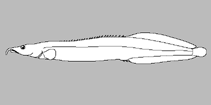
Rückenflossenstacheln (insgesamt) : 19; Rückenflossenweichstrahlen (insgesamt) : 95; Afterflossenstacheln: 3; Afterflossenweichstrahlen: 81; Wirbelzahl: 85. Diagnosis: Mastacembelus kadeiensis differs from all other species of Mastacembelus in having 19 dorsal-fin spines; dorsal fin origin on vertebra 6; first dorsal fin pterygiophore without spine, articulating with neural spine of vertebra 6; base of first dorsal-fin spine above vertebra 8, base of last dorsal fin spine above vertebra 28, base of first anal fin spine below vertebrae 31, above 8 and 22, and below 33 in Mastacembelus sexdecimspinus; branchiostegal rays 4, usually 6 in other Mastacembelus; dorsal-fin rays 95; anal-fin spines 3, 2 much stouter and longer than 1 and 3; anal-fin rays 81; principal caudal-fin rays 5/6, no upper or lower procurrent rays; vertebrae 28+57=85 (Ref. 123814). Most similar species of Mastacembelus kadeiensis is M. sexdecimspinus; it differs from M. sexdecimspinus in having dorsal fin spines 19, vs. 15-16; dorsal-fin rays 95, vs. 112-132; anal-fin rays 81, vs. 81-98; origin of dorsal-fin soft rays above vertebrae 29, of anal-fin soft rays below 35, vs. above vertebra 23 and below 35; vertebrae 28+57=85, vs. 30+58=88 (Ref. 123814). Both have spiny dorsal fin origin above vertebra 6, apparently 4 branchiostegal rays, and 5/6 principal caudal-fin rays; colouration markedly different; that of M. kadeiensis can be compared to that of a typically-coloured M. sexdecimspinus which has entire head and body with dark background colouration closely covered with rows of numerous large roundish pale spots; such colouration is continuous over the entire dorsal and anal fins, lacking a thin white margin, and on ventral surface of head and abdomen which are much lighter in colouration overall; pectoral fin with smaller dark mark near its base and two thin broken vertical bars on its middle (Ref. 123814).Colouration: Live colouration not recorded (Ref. 123814). Colouration of preserved specimens highly distinctive, most notably with a series of bilateral pairs of small round white spots on each side for entire length of dorsum, and 14 bold obliquely-oriented white slash marks on ventral part of body on either side just above anal fin base; dorsal surface of head to well below eye and upper half of gill cover and entire lateral surface of body uniformly dark coloured, without pale marks or pattern; ventral half of head and abdomen entirely pale, without marks or pattern, then a series of ten large sharply defined roundish or oval pale spots on either side of body above anal fin base; dorsal and anal fins darkish overall, with thin white margin; pectoral fin pale overall, with large dark blotch on its base and two thin dark vertical bars in its middle (Ref. 123814).
Lebenszyklus und Paarungsverhalten
Geschlechtsreife | Fortpflanzung | Ablaichen | Eier | Fruchtbarkeit | Larven
Roberts, T.R., 2020. Two new species of the spiny percheel genus Mastacembelus (Synbranchiformes, Mastacembelidae) with low numbers of dorsal fin spines from the Congo basin. Aqua, Int. J. Ichthyol., 26(3-4):69-76. (Ref. 123814)
IUCN Rote Liste Status (Ref. 130435: Version 2025-2 (Global))
Bedrohung für Menschen
Harmless
Nutzung durch Menschen
Tools
Zusatzinformationen
Download XML
Internet Quellen
Schätzungen auf der Grundlage von Modellen
Phylogenetischer Diversitätsindex (Ref.
82804): PD
50 = 0.5000 [Uniqueness, from 0.5 = low to 2.0 = high].
Bayesian length-weight: a=0.00269 (0.00129 - 0.00562), b=2.94 (2.76 - 3.12), in cm total length, based on LWR estimates for this (Sub)family-body shape (Ref.
93245).
Trophische Ebene (Ref.
69278): 3.6 ±0.6 se; based on size and trophs of closest relatives
Widerstandsfähigkeit (Ref.
120179): hoch, Verdopplung der Population dauert weniger als 15 Monate. (Preliminary K or Fecundity.).
Anfälligkeit der Fischerei (Ref.
59153): Low vulnerability (10 of 100).
🛈