Umwelt: Milieu / Klimazone / Tiefenbereich / Verbreitungsgebiet
Ökologie
seewasser bathypelagisch; tiefenbereich 0 - 605 m (Ref. 120632). Tropical
Indo-Pacific. off Hawaii, Japan, Madagascar and Australia.
Größe / Gewicht / Alter
Geschlechtsreife: Lm ? range ? - ? cm
Max length : 19.3 cm SL Männchen/unbestimmt; (Ref. 120578)
Kurzbeschreibung
Bestimmungsschlüssel | Morphologie | Morphometrie
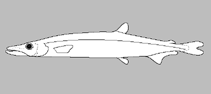
Rückenflossenweichstrahlen (insgesamt) : 9; Afterflossenweichstrahlen: 32 - 35; Wirbelzahl: 87 - 91. This species is distinguished by the following characters: two light organs along orbital margin, one at mid-anterior edge and another at the lower margin; D 9; A 32-35; prehaemal vertebrae 32-36 and total vertebrae 87-91; lateral line scales 69-77; dorsal�fin origin well before mid-space between pelvic- and anal- fin origins; broad black margin on abdominal ridge (Ref. 120632).
Cross section: compressed.
Most likely a mesopelagic species.
Lebenszyklus und Paarungsverhalten
Geschlechtsreife | Fortpflanzung | Ablaichen | Eier | Fruchtbarkeit | Larven
Ho, H.-C. and D. Golani, 2019. A new species of Lestrolepis from the Red Sea, with redescription of Lestrolepis pofi (Harry, 1953) (Aulopiformes: Parelepididae). Zootaxa 4619(3):571-579. (Ref. 120632)
IUCN Rote Liste Status (Ref. 130435: Version 2025-2 (Global))
Bedrohung für Menschen
Harmless
Nutzung durch Menschen
Tools
Zusatzinformationen
Download XML
Internet Quellen
Schätzungen auf der Grundlage von Modellen
Phylogenetischer Diversitätsindex (Ref.
82804): PD
50 = 0.5312 [Uniqueness, from 0.5 = low to 2.0 = high].
Bayesian length-weight: a=0.00186 (0.00078 - 0.00447), b=3.13 (2.92 - 3.34), in cm total length, based on LWR estimates for this (Sub)family-body shape (Ref.
93245).
Trophische Ebene (Ref.
69278): 3.8 ±0.6 se; based on size and trophs of closest relatives
Widerstandsfähigkeit (Ref.
120179): hoch, Verdopplung der Population dauert weniger als 15 Monate. (Preliminary K or Fecundity.).
Anfälligkeit der Fischerei (Ref.
59153): Low vulnerability (14 of 100).
🛈