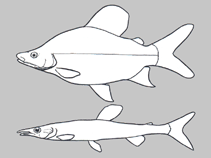
Clasificación / Nombres
Nombres comunes | Sinónimos | Catalog of Fishes(Género, Especie) | ITIS | CoL | WoRMS | Cloffa
>
Characiformes (Characins) >
Distichodontidae (Distichodus)
Etymology: Distichodus: Greek, di = two + Greek, stix, stichos = line, row (Ref. 45335); microps: The specific epithet is a combination of the Greek "micro" and "ops" and refers to the small eye relative to the snout and head length (Ref. 127217).
Entorno: milieu / zona climática / rango de profundidad / gama de distribución
Ecología
; agua dulce bentopelágico. Tropical
Africa: Mbia River drainage in Equatorial Guinea (Ref. 127217).
Tamaño / Peso / Edad
Madurez: Lm ? range ? - ? cm
Max length : 11.1 cm SL macho / no sexado; (Ref. 127217)
Descripción breve
Claves de identificación | Morfología | Morfometría
Espinas dorsales (total) : 0; Radios blandos dorsales (total) : 15 - 17; Espinas anales: 0; Radios blandos anales: 12 - 13. Diagnosis: Distichodus microps is readily distinguished from the larger-bodied, higher-scale count Distichodus species (D. antonii, D. atroventralis, D. fasciolatus, D. lusosso, D. mossambicus, D. sexfasciatus, D. langi, D. rostratus, D. engycephalus, D. kasaiensis, D. ingae, D. polli, D. petersii, D. nefasch, D. brevipinnis and D. schenga) in having fewer lateral line scales, 40-41 vs. more than 60, and in achieving a smaller maximum standard length, less than 15 cm vs. more than 30 cm (Ref. 127217). This species is also distinguished from the smaller-bodied, lower-scale count Distichodus species in the following ways: Distichodus microps is distinguished from D. decemmaculatus and D. teugelsi in having two rows of teeth on the lower jaw vs. one; it can be readily distinguished from D. noboli, D. hypostomatus and D. maculatus in having fewer scales along the lateral line, 40-41 vs. 45, 53-60 and 75 respectively; and distinguished from D. rufigiensis in not having prominent vertical bars along the sides (Ref. 127217). Distichodus microps is distinguished from D. kolleri and D. altus in having fewer dorsal-fin rays, 15-17 total rays vs. 21-26 and 17-18 respectively, and further distinguished from D. altus and D. affinis in having fewer total anal-fin rays, 12-13 vs. 21-22; it is distinguished from D. notospilus in having more scales along the lateral line, 41, rarely 40, vs. 37-39, rarely 40, a nearly inferior mouth vs. subterminal in D. notospilus, a curved posterolateral margin of the opercle vs. straight in D. notospilus, a smaller eye, 56.7-80.4% of snout length vs. 70.1-104.3%, and a less prominent elongated spot at the base of the caudal fin; it is distinguished from D. mbiniensis in having a shallower body, usually six scales from lateral line to the pelvic fin vs. 7, 34.1-38.7% of standard length vs. 33.6-42.4%, fewer anal-fin rays, usually 12 total rays vs. 13-14, a longer anal fin, 15.0-17.8% of standard length vs. 13.4-17.3%, a more inferior mouth vs. the subterminal mouth in D. mbiniensis, a deeper, 12.4-14.2% of standard length vs. 11.8-13.0%, and a longer caudal peduncle , 11.9-14.8% of standard length vs. 9.7-12.6%, a smaller eye, 56.7-80.4% of snout length vs. 58.6-88.0%, a more narrow and elongate subopercle, and a deeper infraorbital 1 with a more rectangular anterolateral margin vs. a more shallow infraorbital 1 with a curved anterolateral margin in D. mbiniensis (Ref. 127217).
Ciclo vital y comportamiento de apareamiento
Madurez | Reproducción | Puesta | Huevos | Fecundidad | Larva
Schmidt, R.C., E.C. Knobloch and C. Barrientos, 2021. Cast netting new species: integrative taxonomy of Distichodus notospilus (Characiformes: Distichodontidae) discovers new species and overlooked areas of endemism in Central Africa. Zootaxa 4952(2):291-313. (Ref. 127217)
Situación en la Lista Roja de la UICN (Ref. 130435: Version 2025-2 (Global))
Amenaza para el ser humano
Harmless
Usos humanos
Herramientas
Informes especiales
Descargar XML
Fuentes de Internet
Estimaciones basadas en modelos
Índice de diversidad filogenética (Referencia
82804): PD
50 = 0.5000 [Uniqueness, from 0.5 = low to 2.0 = high].
Bayesian length-weight: a=0.01445 (0.00602 - 0.03469), b=3.05 (2.86 - 3.24), in cm total length, based on LWR estimates for this Genus-body shape (Ref.
93245).
Vulnerabilidad pesquera (Ref.
59153): Low vulnerability (10 of 100).
🛈