Classificação / Nomes
Nomes comuns | Sinónimos | Catalog of Fishes(Género, Espécies) | ITIS | CoL | WoRMS | Cloffa
>
Cichliformes (Cichlids, convict blennies) >
Cichlidae (Cichlids) > Pseudocrenilabrinae
Etymology: Maylandia: In honour of Hans J. Mayland, German ictiologist (Ref. 45335); koningsi: Named after Adrianus Konings for his comprehensive knowledge and for teaching the author most of what he knows about the fishes of Lake Malawi (Ref. 127491).
Eponymy: Hans-Joachim Mayland (1928–2004) was a German ichthyologist, aquarist, photographer and writer. [...] (Ref. 128868), visit book page.
Ambiente: milieu / zona climática / intervalo de profundidade / gama de distribuição
Ecologia
; Água doce bentopelágico; intervalo de profundidade 15 - ? m (Ref. 127491). Tropical
Africa: Lake Malawi, Malawi (Ref. 127491).
Tamanho / Peso / Idade
Maturidade: Lm ? range ? - ? cm
Max length : 5.7 cm SL macho/indeterminado; (Ref. 127491)
Descrição breve
Chaves de identificação | Morfologia | Morfometria
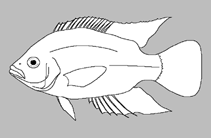
Espinhos dorsais (total) : 17 - 18; Raios dorsais moles (total) : 7 - 9; Espinhos anais: 2 - 3; Raios anais moles: 7 - 8. Diagnosis: The moderately-sloped vomer, 43.1°, with a swollen rostral tip, bicuspid teeth in the anterior portion of the outer row of both upper and lower jaws, the lower jaw at a 45° angle to a line from the tip of the snout to the hypural plate, a lower jaw that is slightly longer than the upper, and its feeding at a 90° angle to the substrate place this species in Maylandia (Ref. 127491). The lack of conspicuous vertical bars on the flank and the dark submarginal band in the dorsal fin of male Maylandia koningsi distinguish it from all other species of Maylandia, except M. usisyae; males of M. usisyae have a gold-coloured flank while this is blue in male M. koningsi (Ref. 127491). Females of M. koningsi are entirely brownish yellow and thus distinguished from those of most other species of Maylandia, except for females of M. flavifemina and M. phaeos; the snout of the latter species is relatively longer than that of M. koningsi, 37.9-44.7% of head length vs. 26.6-33.1%, but females of M. flavifemina cannot reliably distinguished from those of M. koningsi apart from the fact that they have a larger size, maximum 79 mm standard length vs. 49 mm standard length for M. koningsi (Ref. 127491).
This species is a deep-water form and is usually found at depths greater than 15 m (Ref. 127491).
Ciclo de vida e comportamento de acasalamento
Maturidade | Reprodução | Desova | Ovos | Fecundidade | Larvas
Stauffer, J.R. Jr., 2018. Description of Metriaclima koningsi, a new species (Teleostei: Cichlidae) from Lake Malawi, Malawi, Africa. Zootaxa 4370(1):95-100. (Ref. 127491)
Categoria na Lista Vermelha da IUCN (Ref. 130435: Version 2025-2 (Global))
Ameaça para o homem
Harmless
Utilização humana
Ferramentas
Relatórios especiais
Descarregue XML
Fontes da internet
Estimativas baseadas em modelos
Índice de diversidade filogenética (Ref.
82804): PD
50 = 0.5000 [Uniqueness, from 0.5 = low to 2.0 = high].
Bayesian length-weight: a=0.01445 (0.00671 - 0.03113), b=2.99 (2.82 - 3.16), in cm total length, based on LWR estimates for this (Sub)family-body shape (Ref.
93245).
Nível Trófico (Ref.
69278): 2.4 ±0.1 se; based on size and trophs of closest relatives
Resiliência (Ref.
120179): Elevada, tempo mínimo de duplicação da população menor que 15 meses (Preliminary K or Fecundity.).
Vulnerabilidade da pesca (Ref.
59153): Low vulnerability (10 of 100).
🛈