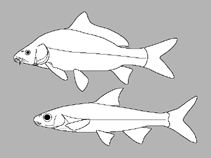
Clasificación / Nombres
Nombres comunes | Sinónimos | Catalog of Fishes(Género, Especie) | ITIS | CoL | WoRMS | Cloffa
>
Cypriniformes (Carps) >
Cyprinidae (Minnows or carps) > Torinae
Etymology: nzadimalawu: Before the Christian missionaries arrived, the Inkisi River was locally referred to as the 'Nzadi malawu' in Kikongo (Kintandu/Kindibu dialects), which means 'the river that brings good luck; the part of the river towards the northern border of Angola still bears this name; species name referring to this ancient name of the river basin to which it seems endemic; a noun in apposition, making its gender ending unchangeable (Ref. 127934).
Entorno: milieu / zona climática / rango de profundidad / gama de distribución
Ecología
; agua dulce bentopelágico. Tropical
Africa: Inkisi River, Lower Congo River basin above the Zongo Falls, in Democratic Republic of the Congo (Ref. 127934).
Tamaño / Peso / Edad
Madurez: Lm ? range ? - ? cm
Max length : 21.3 cm SL macho / no sexado; (Ref. 127934)
Descripción breve
Claves de identificación | Morfología | Morfometría
Espinas dorsales (total) : 0; Radios blandos dorsales (total) : 13 - 15; Espinas anales: 0; Radios blandos anales: 9; Vértebra: 36 - 38. Diagnosis: Within the Congo basin Labeobarbus nzadimalawu can be distinguished from L. altipinnis, L. ansorgii, L. batesii, L. brauni, L. cardozoi, L. caudovittatus, L. dartevellei, L. fasolt, L. habereri, L. humphri, L. iphthimostoma, L. iturii, L. jubbi, L. longidorsalis, L. longifilis, L. lufupensis, L. macroceps, L. macrolepidotus, L. macrolepis, L. mawambi, L. mawambiensis, L. mirabilis, L. nanningsi, L. oxyrhynchus, L. paucisquamatus, L. stappersii, L. trachypterus, L. upembensis and L. wittei by its high number of lateral line scales, 35-41 vs. les than 34; from L. leleupanus by its low number of lateral line scales, 35-41 vs. 45-47; from L. tropidolepis and L. platyrhinus by its low number of scales between the lateral line and the dorsal and ventral midline, 4.5-6.5 and 5.5-6.5 vs. 7.5-8.5 and 7.5-9.5 in L. tropidolepis and 6.5-7.5 and 6.5-8.5 in L. platyrhinus, and from the latter by its low number of circumpeduncular scales as well, 12-16 vs. 16-18; from L. robertsi by the absence of papillae on the anterior edge of the lower jaw vs. with numerous well identifiable papillae; from L. pellegrini by the presence of two pair of well-developed barbels vs. a single pair of minute posterior barbels in L. pellegrini; from L. progenys by its non-prognathous lower jaw vs. prognathous; from L. altianalis and L. gestetneri by the last unbranched dorsal-fin ray not being transformed into a well-developed spine, but instead being clearly segmented for about half of its length, 42.8-57.7% of dorsal-fin height, vs. transformed into a spine, clearly segmented only at its most distal end, less than 30.0% of dorsal-fin height; and from L. somereni, by its high total number of gill rakers on the first gill arch, 18-22 vs. 11, and a, positively allometric, narrow mouth width, 16.1-26.5% of head length vs. 31.3% (Ref. 127934). Further, L. nzadimalawu can be distinguished from both the other members of the Inkisi complex, L. ndazinkisi and the intermediate/hybrid specimens by the presence of a free mental lobe, vs. no mental lobe but instead a cornified Varicorhinus real cutting edge on the outer edge of the lower jaw in L. nzadinkisi and no or only a rudimentary or attached mental lobe in hybrid specimens; in addition, L. nzadimalawu can be distinguished from L. nzadinkisi by its narrow mouth width, 16.1-26.5% of head length vs. 26.8-50.5%, long head length, 23.0-26.4% of standard length vs. 20.1-22.1%; short dorsal-fin base length, 12.1-16.0% of standard length vs. 14.4-17.9%; and long prepectoral distance, 22.6-26.0% of standard length vs. 20.0-22.1%; finally, L. nzadimalawu can be distinguished from Acapoeta tanganicae by its low number of lateral line scales, 35-41 vs. 57-67 (Ref. 127934). Within the adjacent Lower Guinea ichthyofaunal province L. nzadimalawu can be distinguished from L. axelrodi, L. batesii, L. brevispinis, L. cardozoi, L. caudovittatus, L. compiniei, L. habereri, L. fimbriatus, L. jaegeri, L. malacanthus, L. mariae, L. mbami, L. micronema, L. mungoensis, L. roylii, L. sandersi, L. semireticulatus, L. steindachneri, L. tornieri, L. versluysii and L. werneri by its higher number of lateral line scales, 35-41 vs. less than 34; from L. aspius, L. lucius and L. progenys by its non-prognathous lower jaw vs. lower jaw clearly prognathous; and from L. rocadasi by its last unbranched dorsal-fin ray not being transformed into a well-developed spine, but instead being clearly segmented over approximately half its length, 42.8-57.7% of dorsal-fin height vs. last unbranched dorsal-fin ray transformed into a spine, clearly segmented only at its most distal end; finally, L. ndazimalawu can be distinguished from Sanagia velifera by its high number of lateral line scales, 35-41 vs. 22-24 (Ref. 127934). Within the adjacent Quanza ichthyofaunal province, L. nzadimalawu can be distinguished from L. ansorgii, L. gulielmi, L. jubbi, L. nanningsi, L. rhinopterus, L. rosae and L. roylii by its high number of lateral line scales, 35-41 vs. less than 34; from L. clarkeae, L. ensifer and L. varicostoma by the absence of papillae on the anterior edge of the lower jaw vs. with well identifiable papillae; from L. lucius and L. progenys by its non-prognathous lower jaw vs. lower jaw clearly prognathous; and from L. boulengeri, L. ensis, L. girardi, L. steindachneri, L. stenostoma and L. rocadasi by its last unbranched dorsal-fin ray not being transformed into a well-developed spine, but instead being clearly segmented over approximately half its length, 42.8-57.7% of dorsal-fin height vs. last unbranched dorsal-fin ray transformed into a spine, clearly segmented only at its most distal end (Ref. 127934).
Ciclo vital y comportamiento de apareamiento
Madurez | Reproducción | Puesta | Huevos | Fecundidad | Larva
Vreven, E.J.W.M.N., T. Musschoot, E. Decru, S. Wamuini Lunkayilakio, K. Obiero, A.F. Cerwenka and U.K. Schliewen, 2018. The complex origins of mouth polymorphism in the Labeobarbus (Cypriniformes: Cyprinidae) of the Inkisi River basin (Lower Congo, DRC, Africa): insights from an integrative approach. Zool. J. Linn. Soc. 186:414-482. (Ref. 127934)
Situación en la Lista Roja de la UICN (Ref. 130435: Version 2025-2 (Global))
Amenaza para el ser humano
Harmless
Usos humanos
Pesquerías: sin interés
Herramientas
Informes especiales
Descargar XML
Fuentes de Internet
Estimaciones basadas en modelos
Índice de diversidad filogenética (Referencia
82804): PD
50 = 0.5000 [Uniqueness, from 0.5 = low to 2.0 = high].
Bayesian length-weight: a=0.00468 (0.00218 - 0.01003), b=3.10 (2.90 - 3.30), in cm total length, based on LWR estimates for this (Sub)family-body shape (Ref.
93245).
Nivel trófico (Referencia
69278): 3.2 ±0.5 se; based on size and trophs of closest relatives
Resiliencia (Referencia
120179): Medio, población duplicada en un tiempo mínimo de 1.4-4.4 años (Preliminary K or Fecundity.).
Vulnerabilidad pesquera (Ref.
59153): Low vulnerability (16 of 100).
🛈