>
Gadiformes (Cods) >
Macrouridae (Grenadiers or rattails)
Etymology: Coelorinchus: Greek, koilos = a hollow + Greek, rhyngchos = jaw (Ref. 45335); posteromaculatus: Name from Latin 'posteromaculatus' for adjectives 'posterior' meaning further back or hinder and 'maculatus' meaning spotted; referring to the species’ characteristic dark blotch on the anterior part of the tail.
Lingkungan: lingkungan / zona iklim / kisaran kedalaman / jangkauan distribusi
Ekologi
laut batidemersal; kisaran kedalaman 100 - 323 m (Ref. 123275). Tropical
Eastern Indian Ocean.
Ukuran / Berat / umur
Kematangan: Lm ? range ? - ? cm
Max length : 22.0 cm TL jantan/; (Ref. 123275)
deskripsi pendek
Kunci identifiaksi (pengenalan) | Morfologi | Morfometrik
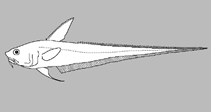
This species is distinguished by the following characters: small, intense, longitudinally elongate, lateral, dark blotch on the anterior part of tail; light organ tubular and externally represented by long black streak covered with scales, extending from immediately in front of anus to chest just posterior to isthmus; underside of head is completely naked except for overlapping scales behind lateral nasal ridges; dorsal surface of snout broadly naked along each side of median rostral ridge; snout long, sharply pointed, its length 74–91% postrostral length (PRL), its dorsal profile gently concave in lateral view; terminal scute long, spearhead shaped, dorsoventrally flattened, with length 16–24% PRL when complete; lateral nasal ridge incompletely supported by nasal bone; anus abutting anal-fin origin; premaxillary teeth small, slender, conical in long, narrow, tapered band, and none distinctly enlarged; posterior margin of the tooth band almost reaching lateral corner of mouth; body scales covered with short, erect, slender spinules in widely divergent rows; spinules in each row completely free from one another, forming comb-like ridge; buttresses of spinules are poorly developed; second dorsal fin distinctly lower than anal fin; upper-jaw length 38–43% PRL; preoral length 65–82% PRL; length of gill slit 21–24% PRL; barbel length 9–14% PRL. Colouration: a slightly diagonal, narrow, dark stripe extending from upper margin of gill opening to below first dorsal-fin midbase or beyond; a faint, diagonal, dark stripe extending from pectoral-fin base to above anal-fin origin; median nasal bone is blackish; underside of head generally pale, without small, blackish, hair-like papillae; lips pale to dusky; front of premaxillary ascending process dusky to dark; oral cavity immaculate; gular and branchiostegal membranes heavily peppered; chest dark; first dorsal fin dusky to dark, with second spinous ray prominently blackish; pelvic fin dusky; pelvic fin heavily peppered (Ref. 123275).
Cross section: oval.
Siklus hidup dan perilaku kawin
Kematangan | Reproduksi, perkembang biakan | Pemijahan | telur-telur | Fekunditas | Larva
Nakayama, N., A.M. Prokofiev and T. Kawai, 2020. Coelorinchus posteromaculatus (Actinopterygii, Gadiformes, Macrouridae), a new species of grenadier from the eastern Indian Ocean. Ichthyol. Res. 67:465-472. (Ref. 123275)
Status IUCN Red List (Ref. 130435: Version 2025-2 (Global))
ancaman kepada manusia
Harmless
penggunaan manusia
Perikanan: tidak ada kepentingan
Alat, peralatan
laporan khas
muat turun XML
Sumber internet
Estimasi berdasarkan model
Indeks keanekaragaman filogenetik (Acuan
82804): PD
50 = 0.5000 [Uniqueness, from 0.5 = low to 2.0 = high].
Bayesian length-weight: a=0.00257 (0.00132 - 0.00501), b=3.19 (3.02 - 3.36), in cm total length, based on LWR estimates for this Genus-body shape (Ref.
93245).
Tingkat Trofik (Acuan
69278): 3.4 ±0.5 se; based on size and trophs of closest relatives
Daya lenting (Acuan
120179): sedang, Waktu penggandaan populasi minimum 1.4 - 4.4 tahun (Preliminary K or Fecundity.).
Kerentanan Penangkapan Ikan (Ref.
59153): Low vulnerability (12 of 100).
🛈