Klassifizierung / Names
Namen | Synonyme | Catalog of Fishes(Gattung, Arten) | ITIS | CoL | WoRMS | Cloffa
>
Perciformes/Scorpaenoidei (Scorpionfishes) >
Triglidae (Searobins) > Triglinae
Etymology: Lepidotrigla: Greek, lepis, lepidos = scale + Greek, trigla, es = red mullet (Ref. 45335); maculapinna: Name from Latin 'macula' meaning spot and 'pinna' for wing; referring to the distinctive dark edged pale blue spots on the inner surface of the pectoral fin that are a characteristic of this species.
Umwelt: Milieu / Klimazone / Tiefenbereich / Verbreitungsgebiet
Ökologie
seewasser demersal; tiefenbereich 100 - 280 m (Ref. 127946). Tropical
Eastern Indian Ocean: Indonesia.
Größe / Gewicht / Alter
Geschlechtsreife: Lm ? range ? - ? cm
Max length : 10.2 cm SL Männchen/unbestimmt; (Ref. 127946)
Kurzbeschreibung
Bestimmungsschlüssel | Morphologie | Morphometrie
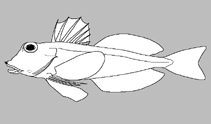
Rückenflossenstacheln (insgesamt) : 8 - 9; Rückenflossenweichstrahlen (insgesamt) : 15 - 16; Afterflossenweichstrahlen: 15; Wirbelzahl: 30 - 31. This species can be distinguished from by the following characters: lateral profile of body with slight convex curve from posterior part of first dorsal fin base to moderately narrow caudal peduncle; with a narrow postorbital notch above and behind each eye, no furrow across nape at rear of interorbital space; rostral process with a broad angular notch having few if any tiny spine tips jutting anteriorly from smooth rostral edge, moderately large triangular spine at apical corner; pored lateral line scales 58-59; scales above lateral line 2 and below about 16 scales; D1 VIII-IX, with first spine slightly shorter than subequal second and third, subsequent spines progressively shorter, D2 15-16; A 15; pectoral fins reaching about fourth or fifth anal fin ray, the first free pectoral fin ray not quite reaching tip of interconnected portion of fin above, extending just to tip of pelvic fin, length of first free ray about equal to length of pectoral fin. Colouration: caudal fin white with broad, red sub distal band and reddish base; inner surface of the pectoral fin blackish with two transverse rows of large darkly ocellated milky blue spots, thin pink distal edge and broad yellow lower margin (Ref. 127939)
Cross section: compressed.
Lebenszyklus und Paarungsverhalten
Geschlechtsreife | Fortpflanzung | Ablaichen | Eier | Fruchtbarkeit | Larven
Gomon, M.F. and T. Kawai, 2018. A review of Indonesia’s Indian Ocean species of Lepidotrigla gurnards (Teleostei: Scorpaeniformes: Triglidae) with descriptions of three new species from southern coastal waters. Raffles Bull. Zool. 66:624-651. (Ref. 127946)
IUCN Rote Liste Status (Ref. 130435: Version 2025-2 (Global))
Bedrohung für Menschen
Harmless
Nutzung durch Menschen
Fischereien: nicht kommerziell
Tools
Zusatzinformationen
Download XML
Internet Quellen
Schätzungen auf der Grundlage von Modellen
Phylogenetischer Diversitätsindex (Ref.
82804): PD
50 = 0.5000 [Uniqueness, from 0.5 = low to 2.0 = high].
Bayesian length-weight: a=0.00912 (0.00425 - 0.01955), b=3.05 (2.87 - 3.23), in cm total length, based on LWR estimates for this (Sub)family-body shape (Ref.
93245).
Trophische Ebene (Ref.
69278): 3.4 ±0.3 se; based on size and trophs of closest relatives
Widerstandsfähigkeit (Ref.
120179): hoch, Verdopplung der Population dauert weniger als 15 Monate. (Preliminary K or Fecundity.).
Anfälligkeit der Fischerei (Ref.
59153): Low vulnerability (10 of 100).
🛈