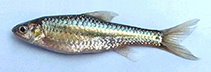
>
Cypriniformes (Carps) >
Cyprinidae (Minnows or carps) > Smiliogastrinae
Etymology: Enteromius: Greek, enteron = intestine + Greek, myo, mys = muscle (Ref. 45335); alberti: Probably, the species epithet alberti is derived from the name of the former 'Parc National Albert', now Virunga National Park, in which the type locality is located (Ref. 127947).
Eponymy: King Albert I (1875–1934) was King of the Belgians (1909–1934). Although the patronym is not identified in either of the original descriptions of these fish, the holotypes were taken in the former Belgian Congo (now DRC). (Ref. 128868), visit book page.
Entorno: milieu / zona climática / rango de profundidad / gama de distribución
Ecología
; agua dulce bentopelágico. Tropical
Africa: river systems throughout the Lake Edward basin and Lake Victoria basin (Ref. 27628, 127947).
Tamaño / Peso / Edad
Madurez: Lm ? range ? - ? cm
Max length : 7.4 cm SL macho / no sexado; (Ref. 127947)
Descripción breve
Claves de identificación | Morfología | Morfometría
Espinas dorsales (total) : 0; Radios blandos dorsales (total) : 10 - 12; Espinas anales: 0; Radios blandos anales: 8 - 9. Diagnosis: Enteromius alberti belongs to the group of species of Enteromius with a flexible last unbranched dorsal fin ray that lacks serrations along its posterior edge (Ref. 127947). It can easily be distinguished from the other species of this group from the East Coast and Nilo-Sudan ichthyofaunal regions by the following combination of characteristics: a complete lateral line vs. an incomplete lateral line in E. atkinsoni, E. pumilus, E. serengetiensis, E. tongaensis and E. toppini; two pairs of barbels vs. one pair in E. pseudotoppini, and no barbels in E. anema and E. profundus; one to three dark spots on the flanks, which sometimes fuse into a mid-lateral line in preserved specimens, starting posterior to the operculum vs. a dark line running from the tip of the snout to the caudal fin base in E. bifrenatus and E. yongei, and a thin dark line from the beginning of the operculum to the caudal fin base in E. viviparus; 12 scales around the caudal peduncle, with one aberrant specimen with 16, vs. 8 in E. leonensis, 9-10 in E. venustus, and 10 in E. magdalenae and E. yeiensis; 4.5 scales between the dorsal fin base and the lateral line vs. 3.5 in E. radiatus, 5.5 in E. unitaeniatus, and 6 in E. usambarae; a dorsal fin length which is larger than the head length vs. a dorsal fin length equal to the headclength in E. innocens; a body depth which is larger than the head length vs. a body depth which is equal to the head length in E. nigeriensis and E. trispilopleura; a pectoral fin length which is 5/6 of the head length vs. 3/4 in E. lineomaculatus, and 2/3 to 3/4 in E. neglectus; a maximum caudal peduncle depth which is 3/5 of the head length vs. 2/5 in E. quadripunctatus (Ref. 127947). Enteromius alberti differs from E. perince by a combination of a smaller body depth, 21.7-31.2% of standard length vs. 33.8-37.5%; a smaller minimum caudal peduncle depth, 10.0-13.6% of standard length vs. 15.0-16.4%; and a smaller maximum caudal peduncle depth, 11.8-15.5% of standard length vs. 17.7-19.4%; it differs from E. stigmatopygus by a combination of a higher number of lateral line scales, 27-34 vs. 20.25; a smaller predorsal distance, 45.7-51.3% of standard length vs. 51.9-55.8%; and a smaller pre-occipital distance, 16.6-21.8% of standard length vs. 22.1-27.3%; it differs from E. mimus by a higher number of lateral line scales, 27-34 vs. 24-27; a smaller preanal distance, 65.1-73.0% of standard length vs. 68.4-74.8%; a larger post-anal distance, 16.3-24.2% of standard length vs. 16.3-19.3%; a smaller body depth, 21.7-31.2% of standard length vs. 26.5-34.3%; a smaller head depth, 15.1-19.0% of standard length vs. 17.8-21.8%; and a smaller pelvic fin length, 15.0-20.9% of standard length vs. 18.2-22.4% (Ref. 127947). Specimens of E. alberti differ from the population of E. cf. mimus from the Lake Edward system by a smaller head depth; in general, a specimen with a head depth smaller than 19% of the standard length can be assigned to E. alberti, specimens with a head depth larger than 19% of the standard length can be assigned to E. cf. mimus; other characters are the higher number of lateral line scales, 27-34 vs. 21-31, the smaller interorbital width, 5.8-8.3% of standard length vs. 6.9-9.9, the smaller pre-pelvic distance, 44.8-53.3% of standard length vs. 48.4-55.4%, the smaller body depth, 21.7-31.2% of standard length vs. 23.5-35.8%, the smaller maximum caudal peduncle depth, 11.8-15.5% of standard length vs. 8.7-19.0%, the smaller minimum caudal peduncle depth, 10.0-13.6% of standard length vs. 7.1-15.9%, and the smaller head width, 10.4-14.2% of standard length vs. 11.6-14.5% (Ref. 127947).
This species may be anadromous but with permanent populations in the upper reaches of larger rivers (Ref. 104796). Feeds on insects, but algae and debris are also taken (Ref. 12523).
Ciclo vital y comportamiento de apareamiento
Madurez | Reproducción | Puesta | Huevos | Fecundidad | Larva
Maetens, H., M. Van Steenberge, J. Snoeks and E. Decru, 2020. Revalidation of Enteromius alberti and presence of Enteromius cf. mimus (Cypriniformes: Cyprinidae) in the Lake Edward system, East Africa. Eur. J. Taxon. 700:1-28. (Ref. 127947)
Situación en la Lista Roja de la UICN (Ref. 130435: Version 2025-2 (Global))
Amenaza para el ser humano
Harmless
Usos humanos
Pesquerías: sin interés
Herramientas
Informes especiales
Descargar XML
Fuentes de Internet
Estimaciones basadas en modelos
Índice de diversidad filogenética (Referencia
82804): PD
50 = 0.5000 [Uniqueness, from 0.5 = low to 2.0 = high].
Bayesian length-weight: a=0.01122 (0.00521 - 0.02417), b=3.01 (2.84 - 3.18), in cm total length, based on LWR estimates for this Genus-body shape (Ref.
93245).
Nivel trófico (Referencia
69278): 3.0 ±0.3 se; based on size and trophs of closest relatives
Resiliencia (Referencia
120179): Alto, población duplicada en un tiempo mínimo inferior a 15 meses (Preliminary K or Fecundity.).
Vulnerabilidad pesquera (Ref.
59153): Low vulnerability (10 of 100).
🛈