分类 / 名称
俗名 | 同种异名 | Catalog of Fishes(属, 种) | ITIS | CoL | WoRMS | Cloffa
Teleostei >
Myctophiformes (Lanternfishes) >
Myctophidae (Lanternfishes) > Gymnoscopelinae
Etymology: Gymnoscopelus: Greek, gymnos = naked + Greek, skopelos, a lantern fish (Ref. 45335).
Eponymy: Professor Dr August Bernhard Brauer (1863–1917) was a German herpetologist and ichthyologist. [...] (Ref. 128868), visit book page.
More on author: Lönnberg.
环境:氛围 / 气候带 / 深度上下限 / 分布范围
生态学
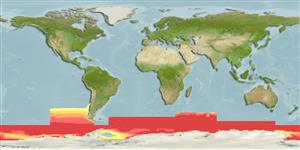
海洋 深海区的; 海洋洄游的 (Ref. 51243); 深度上下限 ? - 2700 m (Ref. 58018). 深水域; 33°S - 78°S
Generally ranges between the coasts of Antarctic and 33°S (south-western Atlantic Ocean sector), 46°S (Indian Ocean sector between 50°-71°E), and about 46°S (Pacific Ocean sector off Chile).
通常在南極圈的海岸與 33 ° S(西南方的大西洋地區), 46 ° S(在 50 °-71 之間的印度洋地區 ° E) 之間為其分佈範圍, 大約 46個 °S.(太平洋地區外海的智利)
大小 / 重量 / 年龄
成熟度: Lm ? range ? - ? cm
Max length : 22.0 cm SL 雄鱼/尚未辨别雌雄; (Ref. 128038)
背棘 (总数) : 0; 背的软条 (总数) : 14 - 17; 臀棘: 0; 臀鳍软条: 16 - 20.
Body shape (shape guide): elongated.
Oceanic and mesopelagic, found in the upper 200 m at night but deeper in the region of Subtropical Convergence (Ref. 4066). Feeds mainly on Euphausia superba; also takes copepods (Euchaeta antarctica, Rhincalanus gigas), amphipods (Primno macropa, Themisto gaudichaudii) and the euphausiid Thysanoessa macrura.
大洋性与海洋中层带的鱼种, 发现于上面的 200 公尺在晚上了但是比较深的在亚热带集中的区域中.(参考文献 4066) 主要吃 Euphausia superba; 也带桡脚类的动物 ( Euchaeta antarctica, Rhincalanus 十亿 ) ,片脚类动物 ( Primno macropa, Themisto gaudichaudii) 与磷虾 Thysanoessa macrura.
生命周期和交配行为
成熟度 | 繁殖 | 产卵场 | 卵 | 孕卵数 | 仔鱼
通常在南極圈的海岸與 33 ° S(西南方的大西洋地區), 46 ° S(在 50 °-71 之間的印度洋地區 ° E) 之間為其分佈範圍, 大約 46個 °S.(太平洋地區外海的智利)
Hulley, P.A., 1990. Myctophidae. p. 146-178. In O. Gon and P.C. Heemstra (eds.) Fishes of the Southern Ocean. J.L.B. Smith Institute of Ichthyology, Grahamstown, South Africa. (Ref. 5182)
世界自然保护联盟红皮书 (Ref. 130435: Version 2025-2 (Global))
人类利用
渔业: 低经济
工具
特别资料
下载 XML
网络资源
基于模型的估算
首选温度 (参考文献
123201): -1.5 - 2.3, mean 0.8 °C (based on 693 cells).
系统发育多样性指数 (参考文献
82804): PD
50 = 0.5039 [Uniqueness, from 0.5 = low to 2.0 = high].
Bayesian length-weight: a=0.00427 (0.00197 - 0.00923), b=3.16 (2.97 - 3.35), in cm total length, based on LWR estimates for this (Sub)family-body shape (Ref.
93245).
营养阶层 (参考文献
69278): 3.2 ±0.3 se; based on diet studies.
Generation time: 3.8 ( na - na) years. Estimated as median ln(3)/K based on 1
growth studies.
回复力 (参考文献
120179): 中等的, 族群倍增时间最少 1.4 - 4.4年 (Preliminary K or Fecundity.).
渔业脆弱性 (Ref.
59153): Low to moderate vulnerability (34 of 100).
🛈
营养素 (Ref.
124155): Calcium = 85.4 [23.8, 229.7] mg/100g; Iron = 0.533 [0.197, 1.652] mg/100g; Protein = 16.3 [14.6, 18.1] %; Omega3 = 0.337 [0.112, 0.973] g/100g; Selenium = 17.7 [5.5, 55.4] μg/100g; VitaminA = 64.9 [7.7, 524.8] μg/100g; Zinc = 0.735 [0.378, 1.570] mg/100g (wet weight); based on
nutrient studies.