>
Anguilliformes (Eels and morays) >
Muraenidae (Moray eels) > Muraeninae
Etymology: Gymnothorax: Greek, gymnos = naked + Greek, thorax, -akos = breast (Ref. 45335); poikilospilus: Name from the Greek ‘poikilo’ for varied or variegated, and ‘spilos’ meaning a spot or stain, referring to its varied body markings between daytime and nighttime.
Entorno: milieu / zona climática / rango de profundidad / gama de distribución
Ecología
marino asociado a arrecife; rango de profundidad 10 - 20 m (Ref. 127463). Subtropical
Northwest Pacific: Taiwan.
Tamaño / Peso / Edad
Madurez: Lm ? range ? - ? cm
Max length : 86.8 cm TL (female)
Descripción breve
Claves de identificación | Morfología | Morfometría
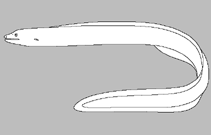
Vértebra: 141. This medium-sized species is distinguished by the following characters: typical muraenid shape, anus at mid-point of body; high dorsal fin; eyes above the mid-jaw; jaws slightly arched, do not completely close; cephalic sensory pores are small; uniserial teeth, are slender and pointed; predorsal vertebrae 4, preanal vertebrae 57-59, total vertebrae 141. Colouration: brown or gray-brown body; several rows of large dark brown patches on back of body and dorsal fin; patches are obscure during daytime and becoming obvious at night; dorsal head dark brown and spotless; when alive, the fins with fine greyish-white margins but these are invisible when preserved; inner skin of nostrils and head pores are whitish; oral cavity uniform brown; throat grooves are darkish; iris of the eye reddish-brown (Ref. 127463).
Cross section: oval.
The holotype was reared from 10 June 2002 until 4 February 2005 in a laboratory aquarium. It accidentally crawled out of the aquarium during the night and died. It was dissected and many mature eggs were found in its abdominal cavity. The mature eggs were between 0.8-1.2 mm in diameter, and batch fecundity was about 20,000 eggs. Under microscope, there was the other immature egg group in its ovaries, the diameters of oocytes were about 0.15-0.26 mm. The paratype was also reared until its death on 22 September 2008. Under the microscope, its gonads belonged to immature ovaries, with 2 groups of oocytes with different egg diameter interval ranges: the larger group was 0.17-0.26 mm, while the smaller group was 0.07-0.13 mm. The two specimens were fed with fish and squid meat (Ref. 127463).
Ciclo vital y comportamiento de apareamiento
Madurez | Reproducción | Puesta | Huevos | Fecundidad | Larva
Huang, W.-C., K.-H. Loh and H.-M. Chen, 2022. Gymnothorax poikilospilus, a new moray eel (Teleostei: Anguilliformes: Muraenidae) from Penghu Islands, western Taiwan. Zootaxa 5189(1):87-102. (Ref. 127463)
Situación en la Lista Roja de la UICN (Ref. 130435: Version 2025-2 (Global))
Amenaza para el ser humano
Harmless
Usos humanos
Pesquerías: escaso valor comercial
Herramientas
Informes especiales
Descargar XML
Fuentes de Internet
Estimaciones basadas en modelos
Índice de diversidad filogenética (Referencia
82804): PD
50 = 0.5000 [Uniqueness, from 0.5 = low to 2.0 = high].
Bayesian length-weight: a=0.00047 (0.00025 - 0.00088), b=3.28 (3.13 - 3.43), in cm total length, based on LWR estimates for this Genus-body shape (Ref.
93245).
Nivel trófico (Referencia
69278): 4.1 ±0.7 se; based on size and trophs of closest relatives
Resiliencia (Referencia
120179): Bajo, población duplicada en un tiempo mínimo de 4.5-14 años (Preliminary K or Fecundity.).
Vulnerabilidad pesquera (Ref.
59153): Moderate to high vulnerability (55 of 100).
🛈