Classificazione / Nomi
Nomi Comuni | Sinonimi | Catalog of Fishes(Genere, Specie) | ITIS | CoL | WoRMS | Cloffa
>
Cyprinodontiformes (Rivulines, killifishes and live bearers) >
Anablepidae (Four-eyed fishes, onesided livebearers & white-eye) > Anablepinae
Etymology: sulfurica: Named after the Spanish adjective 'sulfurica' meaning related to sulfur or from the sulfur, referring to the species' habitat that is rich in sulfur (Ref. 120686).
Eponymy: Reverend Leonard Jenyns (1800–1893) was a clergyman and amateur naturalist. [...] (Ref. 128868), visit book page.
Ambiente: milieu / zona climatica / distribuzione batimetrica / gamma di distribuzione
Ecologia
; acqua dolce pelagico. Tropical
South America: Argentina (Laguna La Quinta, Jujuy Province).
Dimensione / Peso / Età
Maturità: Lm ? range ? - ? cm
Max length : 3.3 cm SL maschio/sesso non determinato; (Ref. 120686)
Breve descrizione
Chiavi di identificazione | Morfologia | Morfometria
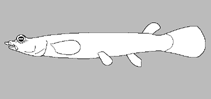
This species can be distinguished by the lack of scales on the ventral surface of the body or having a single row of scales, continuous or not, from the isthmus to the bases of the pelvic fins (vs. completely scaled ventral surface of body); enlarged head and postorbital area compared to other species of the genus; prognathous lower jaw with a hypertrophied lip. Colouration: presenting eight to eleven irregular blotches along the mid-lateral surface of the body, formed by dark-brown chromatophores, ranging from rounded spots to vertical bars stretching up to three scales in depth (vs. different configuration pattern) (Ref. 120686).
A sulfide-tolerant species currently found restricted to the lagoon and ponds in Laguna La Quinta. The surrounding environment has elevated temperatures (39˚-50˚C), low dissolved oxygen concentrations (0.25-5 mg/L) and elevated levels of SO4 (990 to 1015 mg/l). Adults were found mostly in the deepest ponds while juveniles were found schooling in small, shallow ponds (Ref. 120686).
Ciclo vitale e comportamento di accoppiamento
Maturità | Riproduzione | Deposizione | Uova | Fecondità | Larve
Aguilera, G., G.E. Terán, J.M. Mirande, F. Alonso, S. Rometsch, A. Meyer and J. Torres-Dowdall, 2019. Molecular and morphological convergence to sulfide-tolerant fishes in a new species of Jenynsia a (Cyprinodontiformes: Anablepidae), the first extremophile member of the family. PlosONE 14(7):1-19. (Ref. 120686)
Stato della Lista Rossa IUCN (Ref. 130435: Version 2025-2 (Global))
Minaccia per l'uomo
Harmless
Usi umani
Strumenti
Rapporti speciali
Scarica XML
Fonti Internet
Stime basate su modelli
Indice di diversità filogenetica (Fonte Biblio.
82804): PD
50 = 0.5000 [Uniqueness, from 0.5 = low to 2.0 = high].
Bayesian length-weight: a=0.00537 (0.00226 - 0.01277), b=3.15 (2.94 - 3.36), in cm total length, based on LWR estimates for this (Sub)family-body shape (Ref.
93245).
Livello trofico (Fonte Biblio.
69278): 3.0 ±0.4 se; based on size and trophs of closest relatives
Resilienza (Fonte Biblio.
120179): Alto, tempo minimo di raddoppiamento della popolazione meno di 15 mesi (Preliminary K or Fecundity.).
Vulnerabilità della pesca (Ref.
59153): Low vulnerability (10 of 100).
🛈