>
Clupeiformes (Herrings) >
Engraulidae (Anchovies) > Engraulinae
Etymology: Encrasicholina: Greek, egkrasicholos, -os, -on = mixed with spleen; sigma: Name from Greek 'sigma' meaning 'sum total'; referring to the major diagnostic character of the species, total gill rakers of the first gill arch.
Environnement : milieu / zone climatique / profondeur / gamme de distribution
Écologie
marin pelagic-neritic. Tropical
Western Central Pacific: Indonesia.
Taille / Poids / Âge
Maturité: Lm ? range ? - ? cm
Max length : 7.8 cm SL mâle / non sexé; (Ref. 123087)
Description synthétique
Clés d'identification | Morphologie | Morphométrie
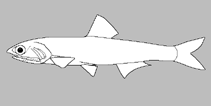
This species is distinguished by the following set of characters: dorsal and anal fins have two unbranched rays; pseudobranchial filaments 17-24 (modally 19); branched pectoral-fin rays 12-14 (13); gill rakers 37-42 (41) on first gill arch, 16-19 (18) in upper series, 21-23 (22) in lower series; gill rakers 31-35 (32) on second gill arch, 12-14 (13) in upper and 19-21 (19) in lower series; gill rakers 18-23 (21) on third gill arch, 9-11 (11) in upper and 9-12 (11) in lower series; gill rakers 16-20 (19) on fourth gill arch, 7-10 (9) in upper and 8-10 (9) in lower series; gill rakers 4-7 (6) on hind face of third gill arch; abdomen with 4-6 (5) spine-like scutes; transverse scales 8 or 9 (9); exposed urohyal bone, no fleshy nobs; head and jaws relatively long, head length 25.2-27.0% (mean 26.1%) of SL, upper jaw length 18.4-20.0% (19.2%) of SL, lower jaw length 16.4-18.1% (17.3%) of SL; anal-fin base is relatively short, 12.9-14.8% (13.9%) of SL; first unbranched dorsal- and anal-fin rays are relatively long, length 4.4-6.5% (5.5%) and 2.7-3.8% (3.4%) of SL, respectively; the distance between dorsal-fin origin and upper end of pectoral-fin insertion is 105.1-121.8% (115.4%) of HL (Ref. 123087).
Cross section: compressed.
Cycle de vie et comportement reproducteur
Maturité | Reproduction | Frai | Œufs | Fécondité | Larves
Hata, H. and H. Motomura, 2020. A new species of anchovy, Encrasicholina sigma (Teleostei, Clupeiformes, Engraulidae), from Sulawesi, Indonesia. Zootaxa 4750(2):261-268. (Ref. 123087)
Statut dans la liste rouge de l'IUCN (Ref. 130435: Version 2025-2 (Global))
Menace pour l'homme
Harmless
Utilisations par l'homme
Outils
Articles particuliers
Télécharger en XML
Sources Internet
Estimations basées sur des modèles
Indice de diversité phylogénétique (Réf.
82804): PD
50 = 0.5005 [Uniqueness, from 0.5 = low to 2.0 = high].
Bayesian length-weight: a=0.00525 (0.00247 - 0.01115), b=3.14 (2.97 - 3.31), in cm total length, based on LWR estimates for this (Sub)family-body shape (Ref.
93245).
Niveau trophique (Réf.
69278): 3.3 ±0.1 se; based on size and trophs of closest relatives
Résilience (Réf.
120179): Haut, temps minimum de doublement de population inférieur à 15 mois (Preliminary K or Fecundity.).
Vulnérabilité de la pêche (Ref.
59153): Low vulnerability (10 of 100).
🛈