>
Clupeiformes (Herrings) >
Engraulidae (Anchovies) > Engraulinae
Etymology: Stolephorus: Greek, stole, -es = garment + Greek, pherein = to carry (Ref. 45335); grandis: Name 'grandis' refers to the larger body of the species when compared with similar species.
Περιβάλλον: περιβάλλον / κλιματική ζώνη / εύρος βάθους / εύρος διανομής
Οικολογία
Θαλασσινό(ά) pelagic-neritic. Subtropical
Western Central Pacific: Indonesia to northern Australia.
Μέγεθος / Βάρος / Ηλικία
Γεννητική Ωρίμανση: Lm ? range ? - ? cm
Max length : 11.6 cm SL αρσενικό/απροσδιόριστο; (Ref. 124636)
Σύντομη περιγραφή
Κλείδες προσδιορισμού | Μορφολογία | Μορφομετρία
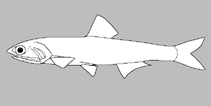
This species is distinguished by the following set of characters: maxilla rather short, 16.7- 18.2% SL (mean 17.5%), its posterior tip slightly short of, or reaching to, or slightly beyond posterior margin of preopercle; mandible short, 14.3–15.3% SL (14.7%); posterior margin of preopercle convexly rounded (not indented); no predorsal scute; prepelvic scutes 3–6 (modally 4); pelvic scute without spine; gill rakers on first gill arch, upper series 14-16 (16), lower series 21–23 (23), total 35-39 (39); gill rakers on second gill arch, upper series 10-12 (11), lower series 18-20 (20), total 28-32 (30); gill rakers on third gill arch, upper series 8-9 (9), lower series 10-12 (11), total 18-21 (20); gill rakers on fourth gill arch, upper series 7-8 (8), lower series 9-10 (9), total 16-18 (17); gill rakers 3-5 (5) on posterior face of the third gill arch; transverse scales 8; pseudobranchial filaments 20-27 (22); parietal and occipital regions with paired dark patches; double dark lines on dorsum from occipital region to dorsal-fin origin but none behind dorsal-fin base; suborbital area and tip of lower jaw wibthout lack spots; head rather short, 22.0-24.0% SL (mean 23.0%), postorbital length 11.5-12.4% SL (11.9%); caudal peduncle long, 21.9-23.7% SL (22.8%); pelvic fin relatively short, 8.3-9.0% SL (8.6%), when depressed not reaching posteriorly to vertical through dorsal-fin origin; distance from snout to pectoral-fin insertion 25.0-27.0% SL (25.6%); distance from snout to pelvic-fin insertion 42.8-44.4% (43.3%); dorsal-fin base is short, 12.6-14.8% SL (13.9%); anal-fin base is short, 16.0-17.8% SL (16.9%); third dorsal-fin ray is short, 14.8-15.7% SL (15.3%); third anal fin ray is short, 11.9-13.8% (12.5%); vertebral count 21 or 22 (modally 21) + 21 or 22 (21) = 42 or 43 (42) (Ref. 124636).
Body shape (shape guide): elongated; Cross section: compressed.
Κύκλος ζωής και συμπεριφορά ζευγαρώματος
Γεννητική Ωρίμανση | Αναπαραγωγή | Γεννοβολία | Αβγά | Γονιμότητα | Προνύμφες
Hata, H. and H. Motomura, 2021. Stolephorus grandis, a new achovy (Teleostei: Clupeiformes: Engraulidae) from New Guinea and Australia. Zootaxa 5004(3):481-489. (Ref. 124636)
Κατάσταση Κόκκινου Καταλόγου IUCN (Ref. 130435: Version 2025-2 (Global))
Απειλή για τον άνθρωπο
Harmless
Ανθρώπινες χρήσεις
αλιεία: Εμπορικό(ά)
Εργαλεία
Ειδικές εκθέσεις
Λήψη XML
Διαδικτυακές πηγές
Εκτιμήσεις βάσει μοντέλων
Δείκτης φυλογενετικής ποικιλότητας (Αναφ.
82804): PD
50 = 0.5000 [Uniqueness, from 0.5 = low to 2.0 = high].
Bayesian length-weight: a=0.00501 (0.00217 - 0.01155), b=3.14 (2.97 - 3.31), in cm total length, based on LWR estimates for this Genus-body shape (Ref.
93245).
Τροφικό Επίπεδο (Αναφ.
69278): 3.3 ±0.4 se; based on size and trophs of closest relatives
Ελαστικότητα (Αναφ.
120179): Υψηλό, ελάχιστος χρόνος για διπλασιασμό πληθυσμού < 15 μήνες (Preliminary K or Fecundity.).
Ευπάθεια στην αλιεία (Ref.
59153): Low vulnerability (10 of 100).
🛈