Clasificación / Nombres
Nombres comunes | Sinónimos | Catalog of Fishes(Género, Especie) | ITIS | CoL | WoRMS | Cloffa
>
Siluriformes (Catfishes) >
Pseudopimelodidae (Bumblebee catfishes, dwarf marbled catfishes) > Batrochoglaninae
Etymology: Microglanis: Greek, mikros = small + Greek, glanis = a fish that can eat the bait without touching the hook; a cat fish (Ref. 45335).
Entorno: milieu / zona climática / rango de profundidad / gama de distribución
Ecología
; agua dulce demersal. Subtropical
South America: Argentina.
Tamaño / Peso / Edad
Madurez: Lm ? range ? - ? cm
Max length : 4.4 cm SL macho / no sexado; (Ref. 128461)
Descripción breve
Claves de identificación | Morfología | Morfometría
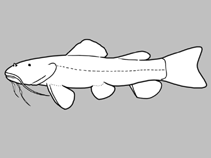
It is distinguished by a thin dark stripe along the middle of the trunk from dorsal-fin origin to end of adipose fin, the absence of a pale area in the nuchal region, and having short serrae on anterior margin of pectoral-fin spine.
It is found in river basins with slow water flow and muddy sandy bottoms. The largest speciment observed was 4.4 cm, standard length, in Argentina. Maximum depth was approximately 0.4 m at the type locality.
Ciclo vital y comportamiento de apareamiento
Madurez | Reproducción | Puesta | Huevos | Fecundidad | Larva
Terán, G.E., L.R. Jarduli, F. Alonso, J.M. Mirande and O.A. Shibatta, 2016. Microglanis nigrolineatus, a new species from northwestern Argentina (Ostariophysis: Pseudopimelodidae). Ichthyol. Explor. Freshwaters 27:193-202. (Ref. 128461)
Situación en la Lista Roja de la UICN (Ref. 130435: Version 2025-2 (Global))
Amenaza para el ser humano
Harmless
Usos humanos
Pesquerías: sin interés
Herramientas
Informes especiales
Descargar XML
Fuentes de Internet
Estimaciones basadas en modelos
Índice de diversidad filogenética (Referencia
82804): PD
50 = 0.5000 [Uniqueness, from 0.5 = low to 2.0 = high].
Bayesian length-weight: a=0.00692 (0.00292 - 0.01638), b=3.12 (2.91 - 3.33), in cm total length, based on LWR estimates for this (Sub)family-body shape (Ref.
93245).
Nivel trófico (Referencia
69278): 3.3 ±0.4 se; based on size and trophs of closest relatives
Vulnerabilidad pesquera (Ref.
59153): Low vulnerability (10 of 100).
🛈