>
Gobiiformes (Gobies) >
Gobiidae (Gobies) > Gobiinae
Etymology: Bathygobius: Greek, bathys = deep + Latin, gobius = gudgeon (Ref. 45335); brasiliensis: Named for the country type locality, Brazil.
Milieu: milieu / Klimaatzone / Diepte / verspreidingsgebied
Ecologie
marien demersaal; diepte 1 - 3 m (Ref. 128474). Tropical
Southwest Atlantic: Brazil.
Grootte / Gewicht / Leeftijd
Maturiteit: Lm ? range ? - ? cm
Max length : 8.1 cm SL mannelijk / geslacht onbekend; (Ref. 128474)
Korte beschrijving
Determinatiesleutels | Morfologie | Morfometrie
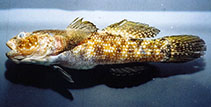
Dorsale stekels (totaal) : 7; Dorsale zachte stralen (totaal) : 9; Anale stekels: 1; Anale zachte stralen: 8. This species is distinguished by the following characters: pectoral-fin rays 18-21; lateral scale rows 34-39; upper jaw length 7.4-10.7% SL (mean 8.9), and rarely more than 10% SL (4 out of 54); predorsal squamation reaching anteriorly to or beyond the anterior border of postorbital blotch; midline predorsal scales 26-30; pelvic fin when depressed falling far of the anus; cheek and operculum often with a few series of minute scales; first upper pectoral-fin ray often branch once, occasionally twice; second to fourth branch more than once; first dorsal-fin outline of adult males somewhat rectangular, while in females and young individuals with a somewhat triangular fin. Small pearly dots present all over the body, head and fins, arranged in horizontal series on body, vertical and horizontal series on fins, and splashed on head specially operculum and preoperculum; yellowish suffusion present everywhere including the outer border of dorsal fins (Ref. 128474).
Cross section: oval.
Collected from reef crests and bottoms, and shallow tidepools everywhere in Fernando de Noronha and Atol das Rocas, up to 3 m deep. Observed in solitary, pairs or in large groups of up to 20 individuals, often in reef crests with rough waters, and eventually in sheltered sandy bottoms. Feeds mainly on small invertebrates, but also on small fishes. The eggs are guarded by territorial males, and their agonistic behaviour. Associated with several species of small fishes: blennies Scartella itajobi, Ophioblennius trinitatis, Entomacrodus vomerinus; labrids Malacoctenus sp., Labrisomus kalisherae, Labrisomus conditus; and the goby Coryphopterus glaucofraenum (Ref. 128474).
Levenscyclus en paargedrag
Maturiteit | Voortplanting | Paaien | Eieren | Fecunditeit | Larven
Rodríguez-Rey, G.T., A. Carvalho-Filho, M.E. de Araújo and A.M. Solé-Cava, 2017. Evolutionary history of Bathygobius (Perciformes: Gobiidae) in the Atlantic biogeographic provinces: a new endemic species and old mitochondrial lineages. Zoological J. Linn. Soc.182(2):360-384. (Ref. 128474)
Status op de Rode Lijst van het IUCN (Ref. 130435: Version 2025-2 (Global))
Bedreigd (EN) (B1ab(iii)+2ab(iii)); Date assessed: 29 January 2024
Gevaar voor de mens
Harmless
Gebruik door de mens
Tools
Speciale rapporten
Download XML
Internetbronnen
Schattingen op basis van modellen
Fylogenetische diversiteitsindex (Ref.
82804): PD
50 = 0.5000 [Uniqueness, from 0.5 = low to 2.0 = high].
Bayesian length-weight: a=0.00741 (0.00347 - 0.01582), b=3.09 (2.91 - 3.27), in cm total length, based on LWR estimates for this (Sub)family-body shape (Ref.
93245).
Trofisch niveau (Ref.
69278): 3.5 ±0.5 se; based on size and trophs of closest relatives
Weerstandsvermogen (Ref.
120179): Hoog, minimale populatieverdubbelingstijd minder dan 15 maanden (Preliminary K or Fecundity.).
Kwetsbaarheid van de visserij (Ref.
59153): Low vulnerability (10 of 100).
🛈